Who Invented the Traffic Light?
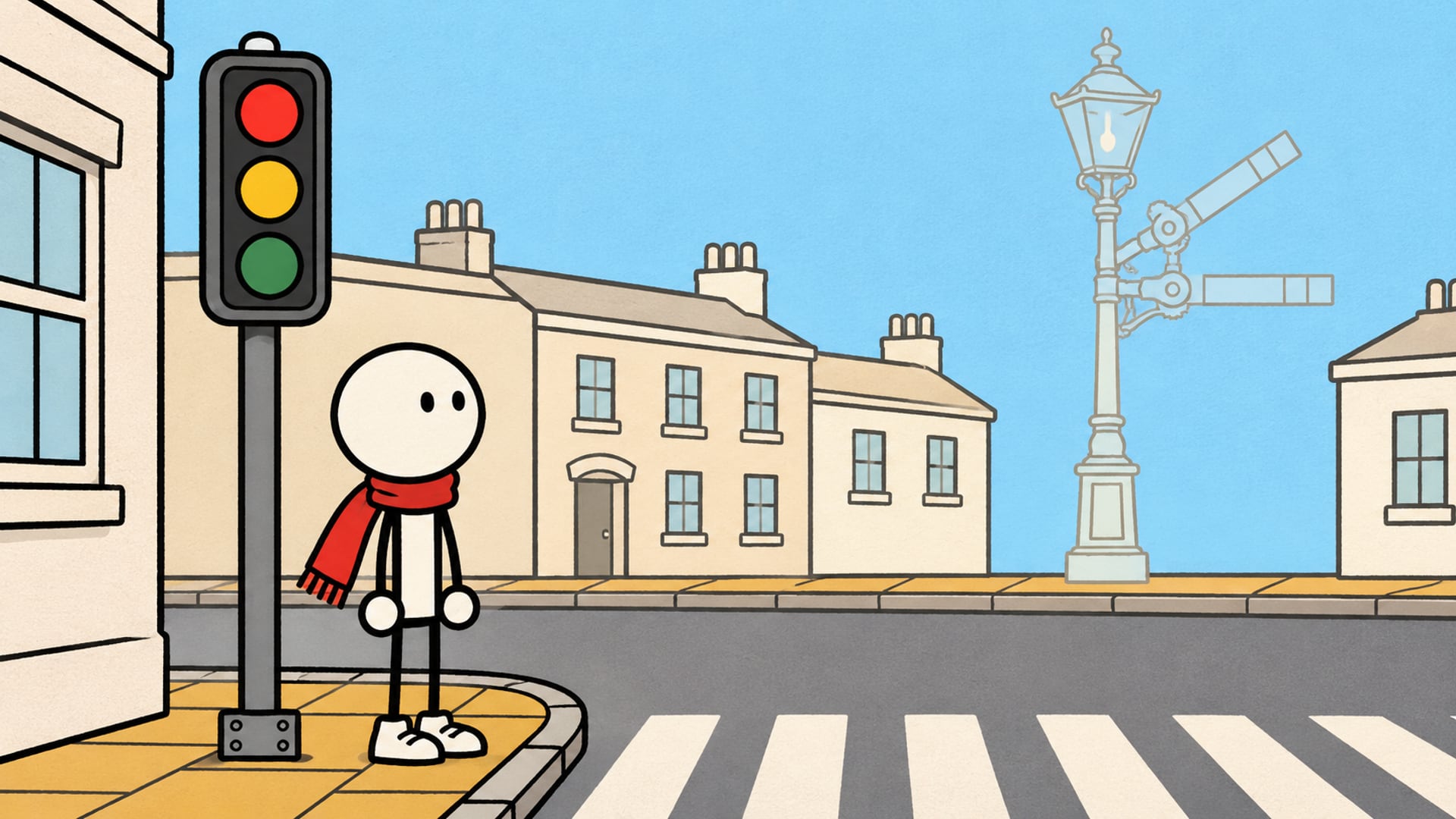
John Peake Knight, a British railway manager and engineer, is usually credited with the first traffic signal, installed in London on 9 December 1868. It used railway-style semaphore arms by day and red and green gas lamps by night, and a constable worked it by hand. The electric, three-color light came later, in the United States.

In this explainer +
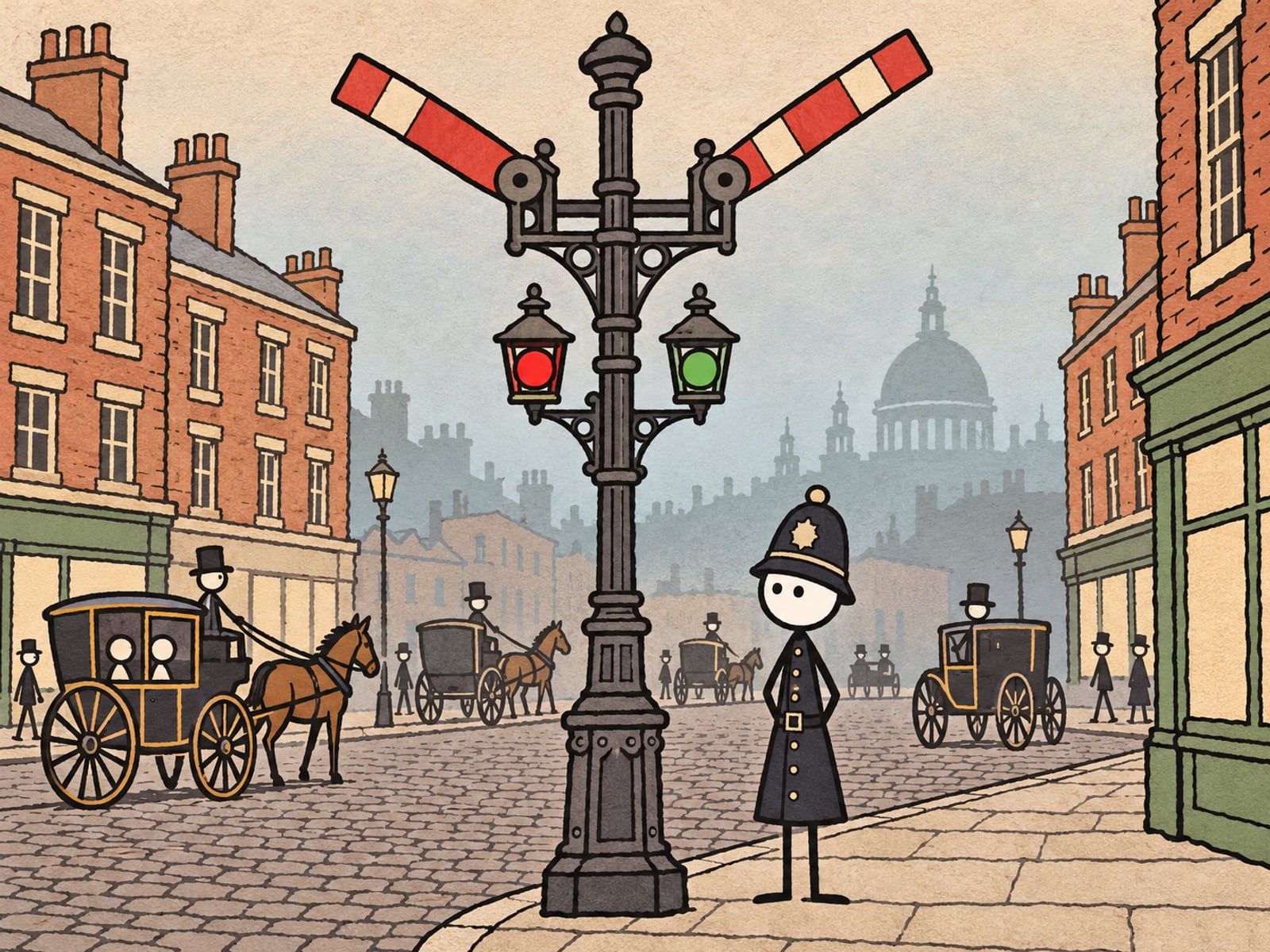
It's 9 December 1868, at Great George Street and Bridge Street, near Westminster Bridge in London, and a police constable is standing beside a tall signal.
According to the Chartered Institution of Highways and Transportation, the signal has semaphore arms that rise and fall, plus red and green gas lamps for the dark. Horse carriages roll past. Pedestrians wait. It's the first traffic signal London has ever seen.
The man usually credited with it is John Peake Knight, a British railway manager and engineer, according to the Oxford Dictionary of National Biography. He took railway semaphore signaling and adapted it for horse-drawn street traffic. A person, not a machine, worked it by hand.
That's the answer to "who invented the traffic light?" The rest of the story is how a gas lamp on a London street turned into the red, yellow and green at your next crossing, and why the colors are what they are.
A gas lamp and a constable
Before 1868, busy crossings in London had no consistent mechanical system. Police officers and other traffic controllers did the job, standing in the street with hand signals, gestures and whistles. Knight proposed something borrowed from the railways: semaphore arms, the same kind of signal railway engineers already used to tell a train what to do from far away.
His version went up at Westminster. By day, movable arms indicated stop or proceed. At night, red and green gas lamps showed the same instructions. A constable operated the mechanism manually.
Then came January 1869. A gas leak caused an explosion, and the constable operating the signal was seriously burned, as the Smithsonian Magazine tells it. The signal was removed.
London did not get traffic lights again until 1926.
In other words, the first traffic light lasted only weeks, and it ended with an explosion. The idea, though, had already been put on the street where everyone could see it.
Electric signals cross the Atlantic
The next steps happened in the United States, and several people have a real claim, depending on which milestone you mean: first road signal, first electric signal, first automatic system, first three-color signal, or first patented device. The FBI's historical account of early signals and the Washington State University Magazine cover most of what follows.
In Chicago, Ernest E. Sirine filed a patent on 28 April 1910 for a motor-driven system of moving semaphore arms marked "stop" and "proceed." It was granted on 10 November 1910. That makes him an early patent holder for an automatic traffic-control mechanism, not the maker of the first installed electric light.
In 1912, in Salt Lake City, Lester Wire, a police officer in charge of the city's traffic squad, built a two-color electric signal with red and green lights. It was an important early electric design. He did not patent it.
Then Cleveland. On 5 August 1914, an electric system went into operation at East 105th Street and Euclid Avenue. It was patterned largely after a design by James B. Hoge, who applied for a patent in 1913 and was granted it on 1 January 1918 for a "Municipal Traffic Control System." The Cleveland installation used red and green and could be controlled manually or by an automatic timer.
Notice what changed. The arms and the gas were gone, and electricity did the work. But the lights were still two colors, red and green, just as in London.
Yellow, and an all-stop
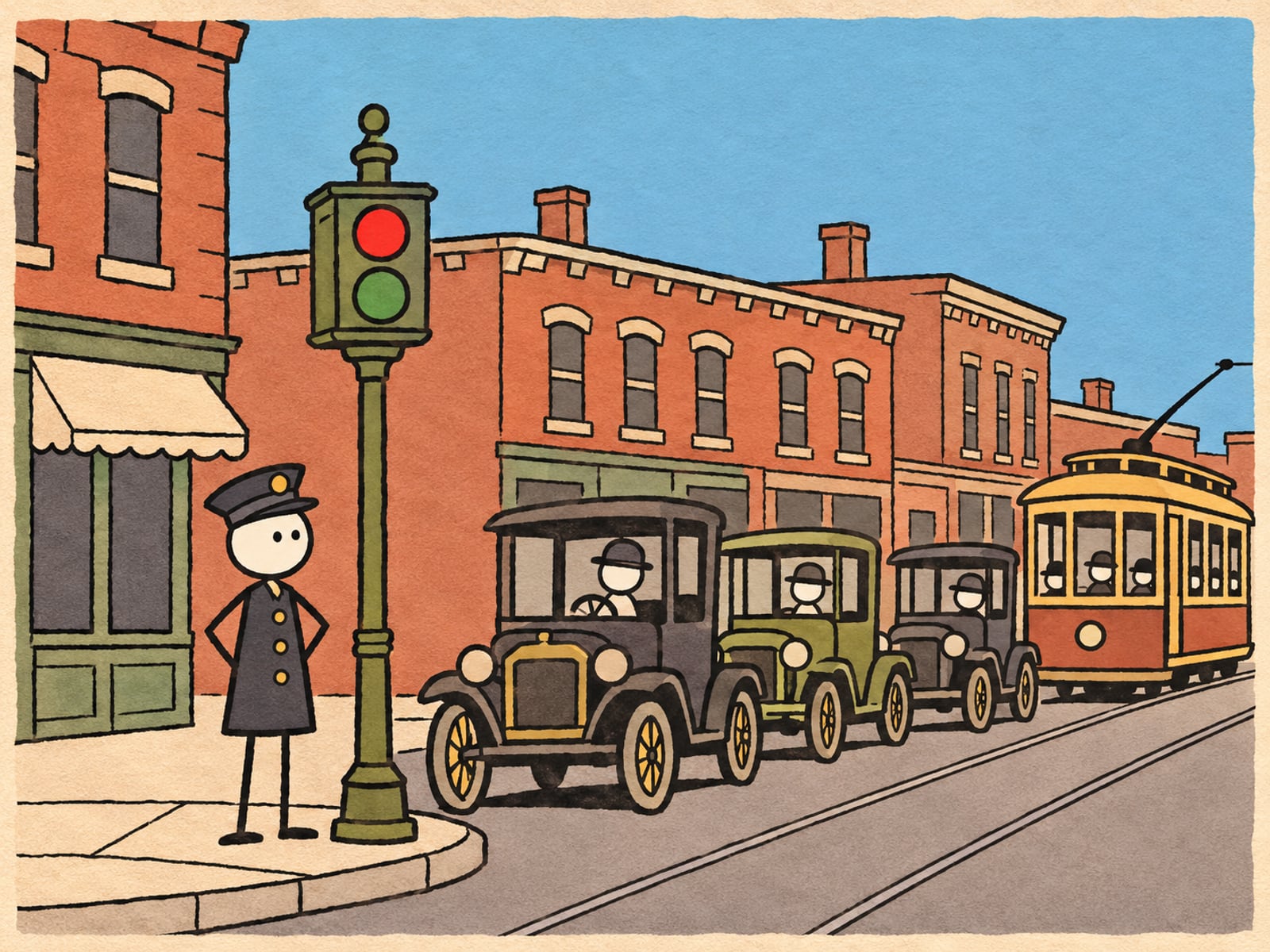
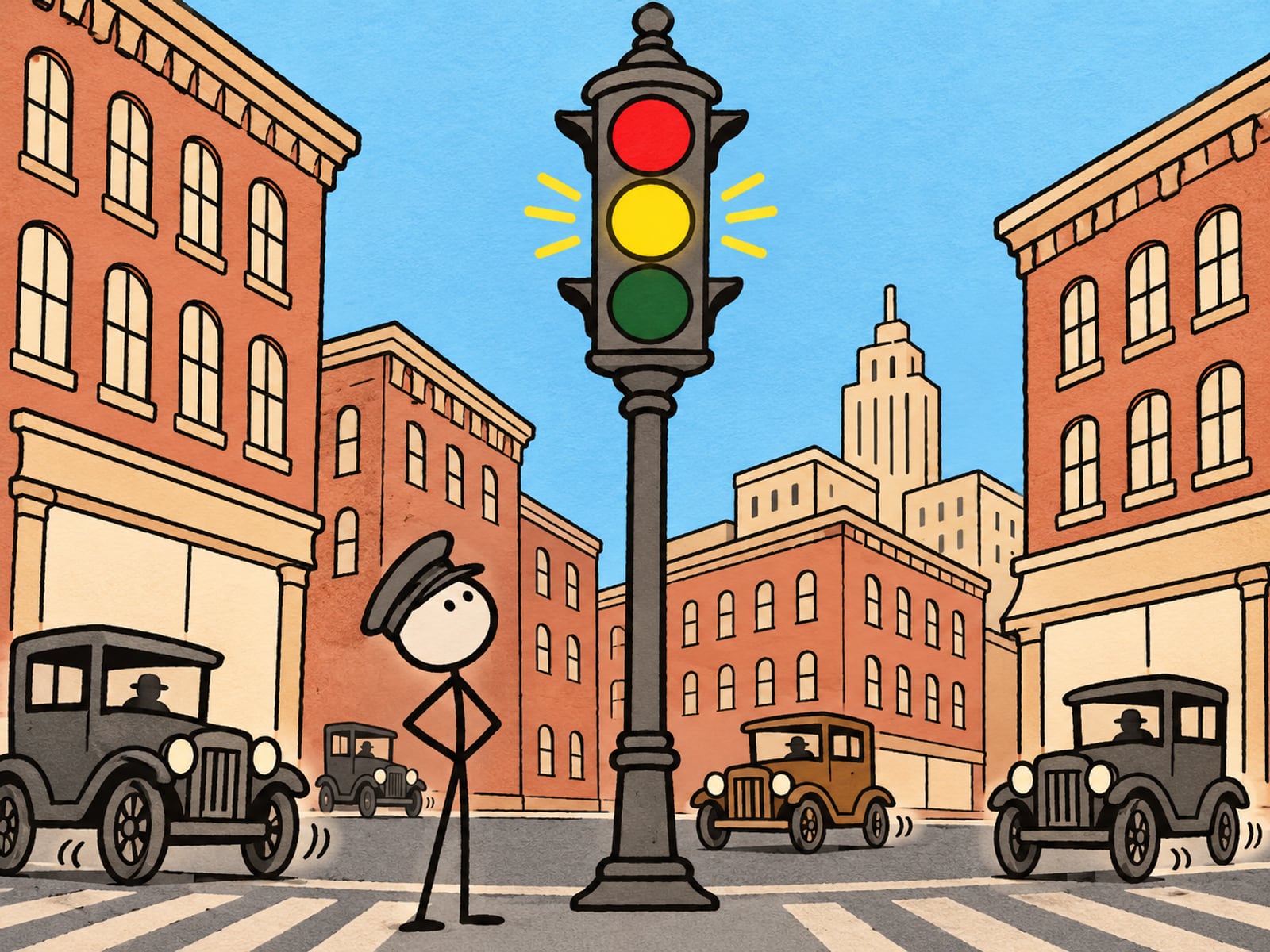
The design most like today's light comes from Detroit. William L. Potts, a police officer in the city, added the yellow warning light between red and green, according to the Library of Congress. In 1920 he built the first four-direction, three-color signal, as Google Arts & Culture describes it. Potts reportedly did not patent it, because he was a city employee.
Yellow had a job to do: warn that the signal was about to change from green to red.
Garrett A. Morgan of Cleveland belongs in this story too, for a different reason. He filed his application on 27 February 1922, and his patent was granted on 20 November 1923. What it covered, per the patent itself, was a manually operated, hand-cranked semaphore with three positions: traffic moving one way, traffic moving the other way, and an all-stop position in between.
That middle position is the point. It let an intersection clear before traffic started in the other direction. It's a safety design, and a smart one. It is not the first traffic light, and the patent did not claim the modern red, yellow and green arrangement.
After that, signals kept improving. Late in the 1920s, most U.S. cities were adopting pre-timed systems. Today, signals use electronic controllers, vehicle and pedestrian detection, countdown displays, audible indications and LED lamps. The basic red, yellow and green sequence is still easy to recognize.
The colors came from the railways
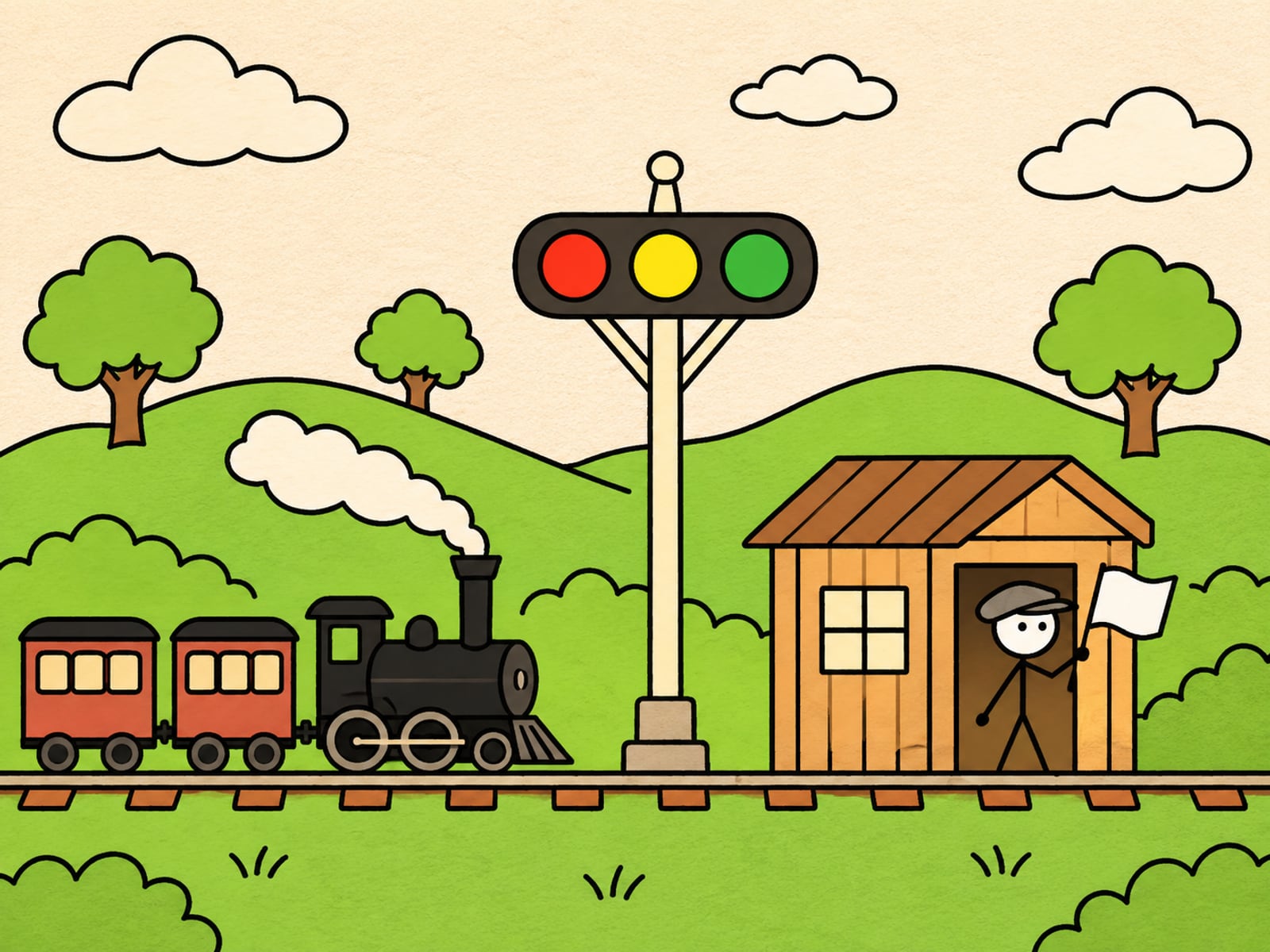
Why those three colors? Road signals copied railway signals. On the railways, red meant danger and stop. Green began as a caution color on some railway systems, then increasingly came to mean clear, or proceed. Yellow became the railway warning color in the early twentieth century, replacing green for caution in systems such as the Great Central Railway in 1917, according to a U.S. government publication on railway signal colors and the Science Museum Group's railway signal collection.
Railway engineers already had a visible way to say stop, warning and proceed over a long distance. Road engineers used it. Knight's 1868 lamps were red and green. Hoge's system used red and green. Potts added the yellow.
Think of it like this: the next time you wait at a red light, you're obeying a code that was written for trains.
The record
| Date | What happened | Source |
|---|---|---|
| 9 December 1868 | Knight's hand-worked signal is installed at Great George Street and Bridge Street, London | CIHT |
| January 1869 | A gas leak causes an explosion that seriously burns the constable; the signal is removed | Smithsonian Magazine |
| 28 April 1910 | Ernest E. Sirine files a patent for a motor-driven semaphore system; granted 10 November 1910 | FBI |
| 1912 | Lester Wire builds a two-color electric signal in Salt Lake City | WSU Magazine |
| 5 August 1914 | Cleveland's electric system starts at East 105th Street and Euclid Avenue | FBI |
| 1920 | William L. Potts builds the first four-direction, three-color signal in Detroit | Google Arts & Culture |
| 20 November 1923 | Garrett A. Morgan's hand-cranked semaphore patent is granted | Google Patents |
| 1926 | London gets traffic lights again | CIHT |
Questions people ask
Who invented the traffic light? 01
It depends on the milestone. John Peake Knight is usually credited with the first traffic signal, in London in 1868. Lester Wire built an early electric red and green signal in 1912, and William Potts built the first four-direction, three-color signal in 1920.
What did Garrett Morgan patent? 02
A manually operated, hand-cranked semaphore with three positions, including an all-stop position that let an intersection clear. The application was filed on 27 February 1922, and the patent was granted on 20 November 1923.
Why are traffic lights red, yellow and green? 03
Road signals copied the railways, where red meant stop and danger. Knight's lamps and Hoge's system used red and green, and Potts added yellow to warn that a change was coming.
What does yellow mean at a traffic light? 04
The color family is shared, but the legal meaning comes from local road rules. In the UK, the Highway Code says steady amber generally means stop, unless the vehicle has crossed the stop line or stopping could cause an accident. Spain's DGT says steady yellow means stop, as for red. Mexico's national standard, NOM-034-SCT2/SEDATU-2022, says amber warns that red is about to begin.
The railway code at the crossing
The signal at the next crossing still uses the railway color code, with yellow as the warning. Spanish speakers call it a semáforo, and Spain's first one, in Madrid in 1926, rests on an El País account.
The machinery changed completely: gas to electricity, a constable's hands to a timer, two colors to three. The colors barely moved.
The first traffic light was a gas lamp that a constable worked by hand in London, and its colors came from the railways.
Sources

- Chartered Institution of Highways and Transportation, "Traffic light anniversary reached in London"
- Oxford Dictionary of National Biography, John Peake Knight
- Smithsonian Magazine, "When street light first came to London, disaster ensued"
- FBI Law Enforcement Bulletin, March 1941
- Washington State University Magazine, "Traffic signals: a brief history"
- Library of Congress, "Taking on traffic: a closer look at the signals"
- Google Arts & Culture, "First tri-color four-directional traffic signal, 1920"
- Google Patents, Garrett A. Morgan, US1475024A
- U.S. government publication on railway signal colors (GovInfo)
- Science Museum Group, railway signal collection
- UK Highway Code, "Light signals controlling traffic"
- Spain, Dirección General de Tráfico, bicycle user guide 2022
- Mexico, NOM-034-SCT2/SEDATU-2022
- El País, "First traffic signal in Madrid"