Why Are Airplane Windows Round?

Airplane windows are round or oval because a curve gives the force on the fuselage a smooth path around the opening, while a corner piles stress into one small spot. Every flight pressurizes the cabin again, and a crack at a stressed corner can grow a little with each cycle. The 1954 Comet crashes taught the industry that lesson.

In this explainer +
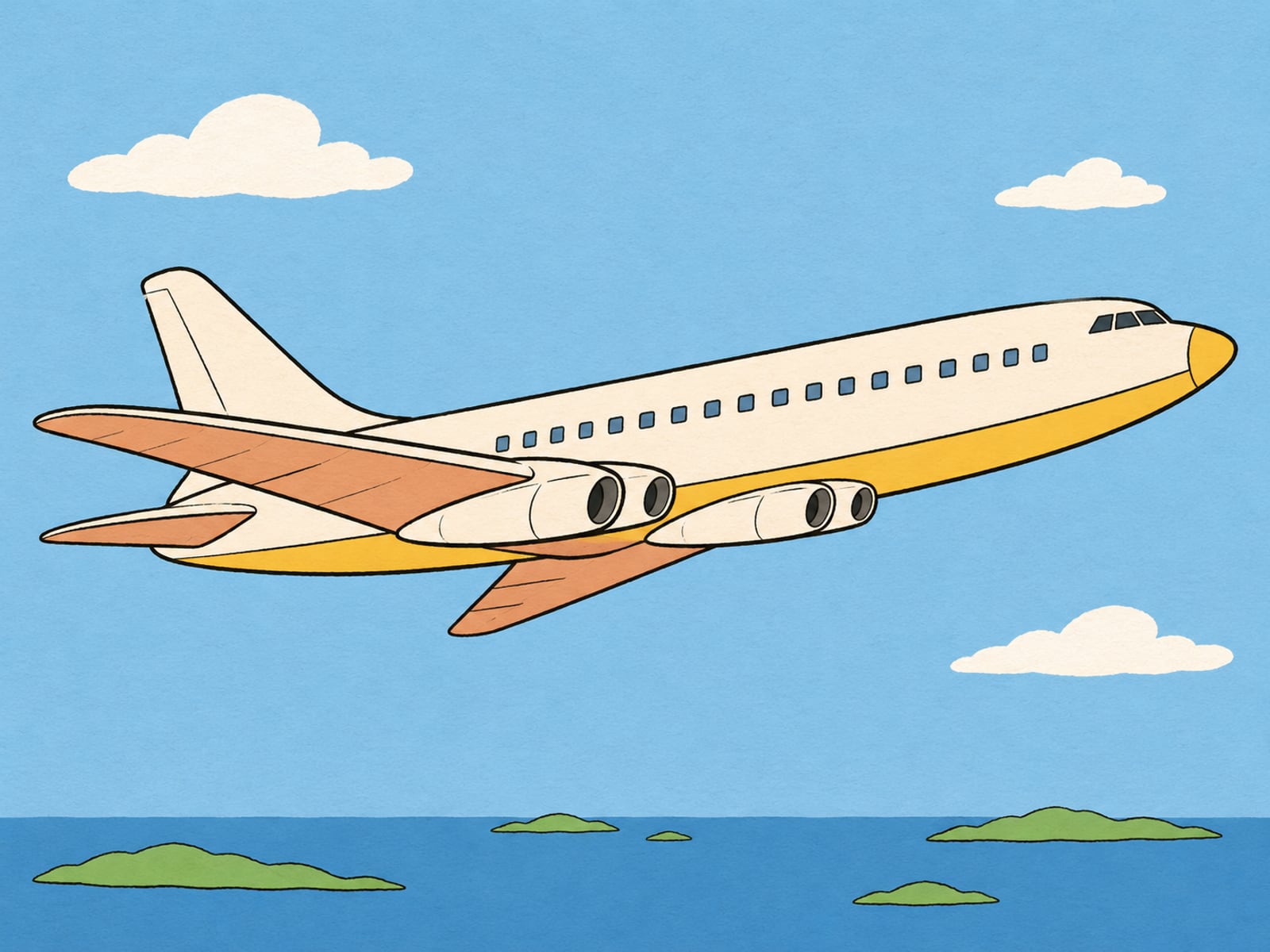
The de Havilland Comet was the world's first commercial jet airliner, and BOAC put it into scheduled service on 2 May 1952.
Then, on 10 January 1954, Comet G-ALYP broke apart while climbing near the island of Elba.
Here is the answer to the question on your window seat. Airplane windows are round or oval because a curved opening spreads the stress of repeated cabin pressurization more evenly than a sharp corner does. The Comet's windows were squarish, with tight corner radii, not square. And the first fracture in the Elba breakup began at a window on the roof, not at a passenger window.
The rest is how engineers worked that out, one tank of water at a time.
Two Comets, three months apart
The Comet carried about 36 passengers at roughly 450 mph, or 720 km/h, and could fly around 40,000 feet. That was far higher and faster than the piston-powered airliners of the day. The cabin was pressurized so people could sit comfortably up there.
On 10 January 1954, BOAC Flight 781, Comet G-ALYP, left Rome Ciampino Airport for London. While climbing through approximately 27,000 feet near Elba, it broke apart in flight and fell into the Mediterranean. All 35 people aboard died, 29 passengers and six crew. The details are in the FAA Lessons Learned page.
BOAC suspended Comet services while the aircraft were inspected and modified. On 23 March 1954, with the cause still unknown, the British Minister of Transport and Civil Aviation allowed passenger flights to resume.
Then came 8 April. South African Airways Flight 201, flown under charter through BOAC by Comet G-ALYY, left Rome for Cairo. Climbing through approximately 35,000 feet near Naples, it broke apart over the Mediterranean. All 21 people aboard died.
BOAC suspended all Comet flights again. On 12 April 1954, the UK withdrew the Comet's Certificate of Airworthiness, which grounded the fleet.
The water tank at Farnborough
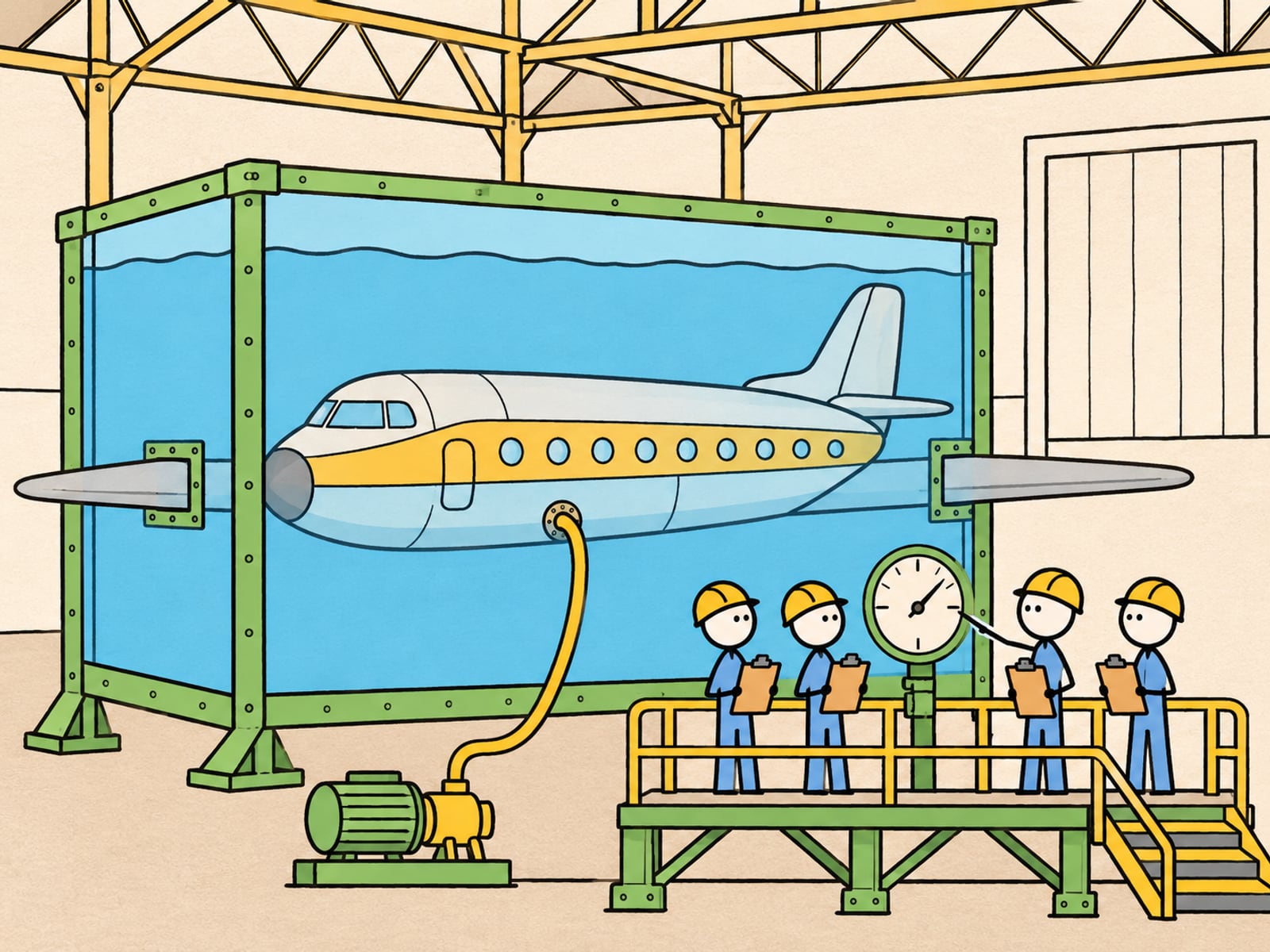
Sir Arnold Hall, Director of the Royal Aircraft Establishment at Farnborough, led the technical work. His team took a Comet, G-ALYU, nicknamed Yoke Uncle, and placed it in a big water tank.
Why water? Because water is far less compressible than air, so a rupture is much less destructive. Water pumped into the fuselage stood in for cabin pressure, and hydraulic equipment pushed on the wings. In other words, the team could squeeze and release the airplane over and over without it blowing apart.
The cabin's normal pressure difference was about 8.25 psi, called 1P. The tank compressed about a three-hour flight into roughly ten minutes. Yoke Uncle had already flown about 1,230 pressurized flights. After about 1,830 more cycles in the tank, the fuselage failed, for a total of about 3,060 cycles.
The crack began at a corner of the forward escape-hatch window, and it looked like metal fatigue. That pointed the investigation at repeated pressurization rather than one big overload.
Investigators then used the tank result to look for the same kind of damage in the Elba wreckage. A recovered piece of the roof held the two squarish Automatic Direction Finder windows, known as the ADF windows, just forward of the wings. It showed the pattern of a fatigue fracture. The RAE determined that this was where the Elba breakup began.
The public Court of Inquiry, chaired by Lord Cohen, sat from 19 October to 24 November 1954. It accepted that metal fatigue of the pressure cabin caused the Elba failure, according to the Court of Inquiry report. It considered the same explanation applicable to Naples, though too little wreckage was recovered for a completely definite finding there.
Why the tests missed it
Here is the twist. The Comet had been tested hard, and that was part of the problem.
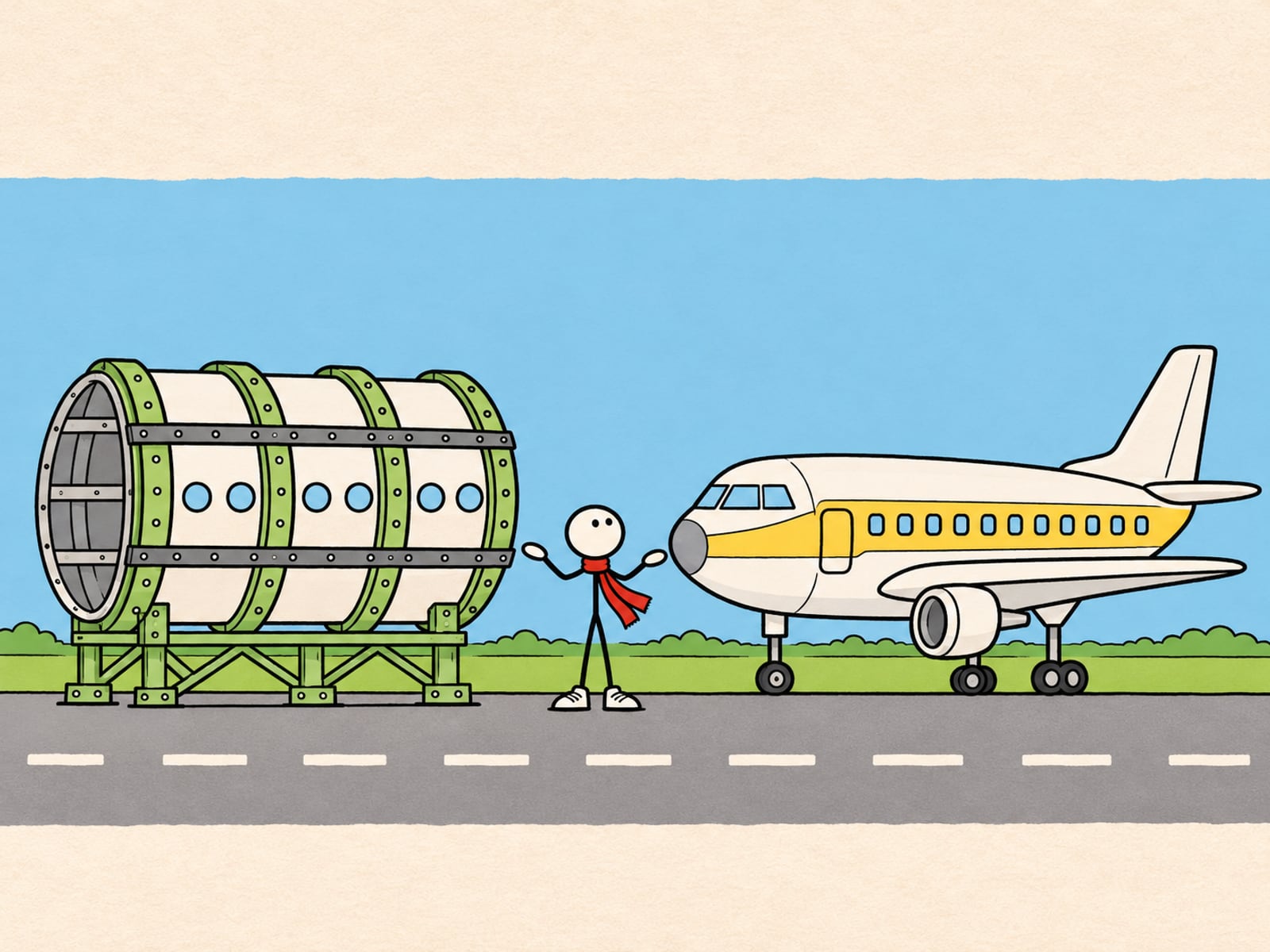
de Havilland's prototype fuselage was designed for 2.5P and proof-tested to 2P, when the rule required 1.33P. Then the same prototype was used for fatigue testing. Those early high-pressure cycles had cold-worked the aluminum around the window corners, which improved its fatigue resistance in those spots. The prototype lasted about 16,000 fatigue cycles.
Production Comets never got that treatment. They reached only around 1,000 pressurization cycles. In other words, the test article had been quietly toughened, and it hid the weakness the real airplanes carried.
How a corner turns into a crack
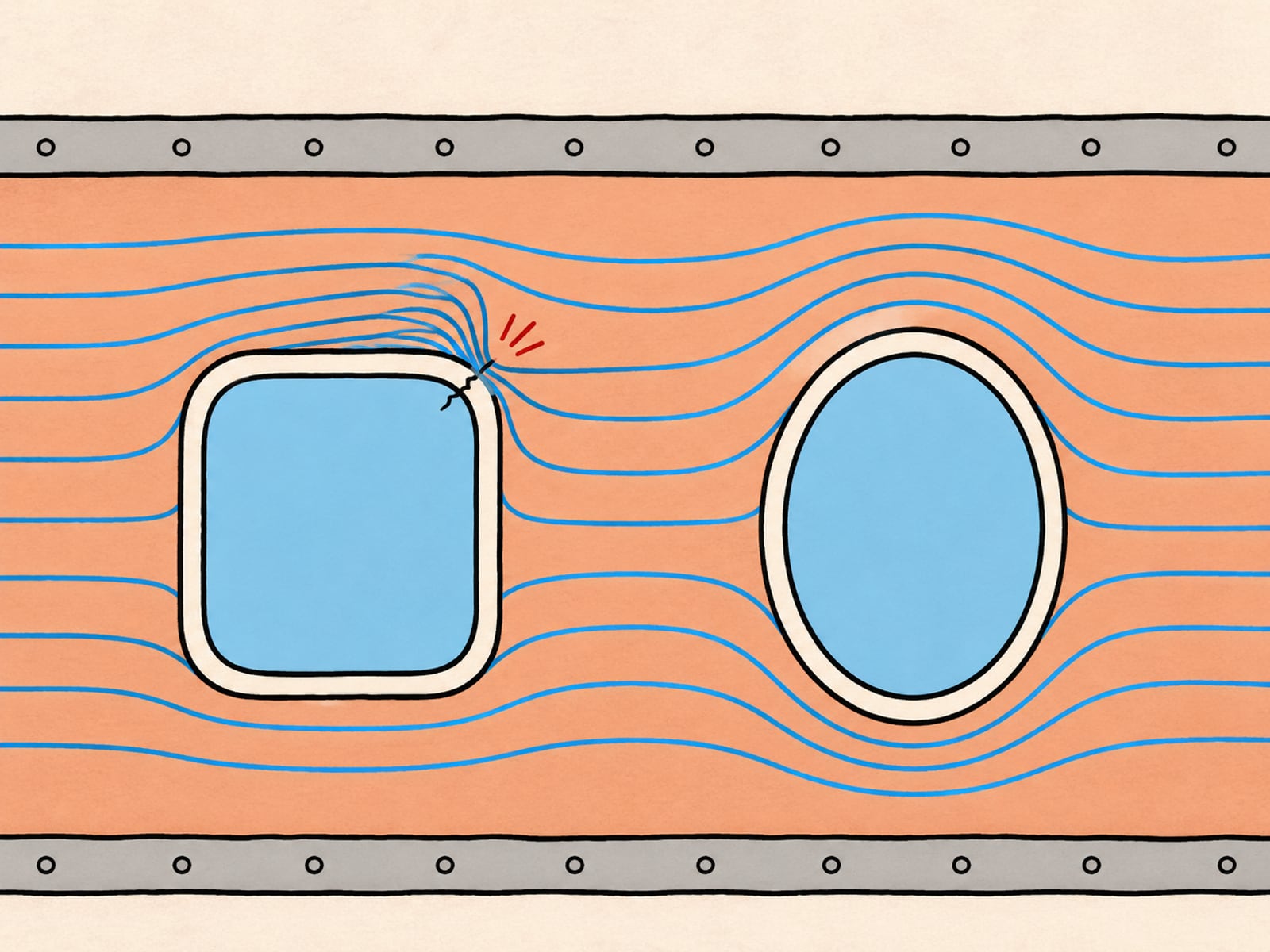
Think of it like this: force moving through a metal skin is like a crowd moving down a corridor. Cut a hole in the wall and the crowd has to squeeze around it. At a sharp corner, everyone jams into one small spot. At a curve, they flow past.
That is a stress concentration. A cutout interrupts the smooth flow of force, and a sharp corner packs the load into a small area. Each pressurization cycle stretches the fuselage a little, and each depressurization releases it. A microscopic crack can start at the stressed corner and grow a little farther every cycle, as this Stanford engineering lecture lays out. A rounded or oval opening gives the load a smoother path and lowers the peak stress.
The Comet's corners were tight, and they produced higher local stresses than de Havilland's calculations had predicted.
What changed after the Comet
The Comet 1XB conversion strengthened the fuselage and replaced the squarish passenger windows with rounded or oval ones, as the RAF Museum's Comet 1XB record notes. The Comet 4 returned the type to commercial service in 1958, with a substantially redesigned fuselage, thicker skin and rounded window openings.
The lesson went beyond window shape. Cutouts, fasteners, skin thickness, load paths and fatigue life all had to be judged together.
The rules changed too. In July 1956, the UK revised British Civil Air Requirements D3-7 to require fatigue testing of a pressure cabin that had not already been used for strength proof testing. The US adopted damage-tolerance certification through Amendment 25-45 to 14 CFR 25.571 in 1978. In Europe, EASA CS-25.571 also requires fatigue and damage-tolerance evaluation and singles out windows, doors and other cutouts for special attention.
The record
| Date | What happened | Source |
|---|---|---|
| 2 May 1952 | BOAC enters the Comet into scheduled service | RAF Museum |
| 10 January 1954 | Comet G-ALYP (BOAC Flight 781) breaks apart near Elba; all 35 aboard die | FAA Lessons Learned |
| 23 March 1954 | Passenger services resume while the Elba cause is still unknown | Court of Inquiry report |
| 8 April 1954 | Comet G-ALYY (South African Airways Flight 201) breaks apart near Naples; all 21 aboard die | FAA Lessons Learned |
| 12 April 1954 | The UK withdraws the Comet's Certificate of Airworthiness | UK Parliament Hansard |
| 19 October to 24 November 1954 | Court of Inquiry sits under Lord Cohen | Court of Inquiry report |
| July 1956 | UK revises BCAR D3-7 on fatigue testing of pressure cabins | FAA Lessons Learned |
| 1958 | The redesigned Comet 4 returns the type to commercial service | BAE Systems Heritage |
| 1978 | US adopts damage-tolerance certification through Amendment 25-45 | Federal Register history |
Questions people ask
A few follow-ups come up every time someone looks at that window again.
Why do airplane windows have a tiny hole? 01
A modern cabin window has several acrylic panes. The outer pane carries the cabin pressure, a middle pane is the backup, and the inner pane protects the others. The small vent hole lets pressure equalize between the panes, according to Airbus Safety First, so the inner pane does not carry the normal pressurization cycles.
Why are airplane fuselages cylindrical or rounded? 02
The fuselage is a pressure vessel. A rounded shape spreads the cabin pressure around the shell and avoids loads piling up in one place, which is the same idea as the window.
Why are airplane windows rounded rectangles instead of perfect circles? 03
Stress is only part of the design. Engineers also balance the viewing area, the seating layout and the shape of the surrounding fuselage structure. A rounded or oval opening gives a smooth path for the load while still giving a passenger something to look out of.
Why do modern aircraft need fatigue inspections if the structure is designed not to crack? 04
Damage-tolerance engineering assumes small damage may happen. The structure is built so that damage can be found by inspection, or the part replaced, before it becomes critical. Windows and doors get special attention because they are cutouts.
Every flight starts the count again
Modern airliners still inspect important cutouts such as windows and doors for fatigue, because every flight pressurizes the cabin again. The 1956 UK rule change points at the testing lesson: fatigue tests need a pressure cabin that has not already been through a strength proof test.
So, the next time you sit by the window and run a finger along the edge, you are touching the answer. A sharp corner concentrates stress, and a curve spreads it out.
Video transcript +
In 1954, the world's first jet airliner broke apart in the sky, twice in three months.
It was the de Havilland Comet, and it flew higher and faster than any passenger plane before it.
Up there, the cabin is pumped full of air so people can breathe, so the body swells a little on every flight and shrinks again when it lands.
To find the problem, engineers sank a Comet's body in a giant water tank and did that to it, over and over.
Thousands of "flights" later, the body split open, starting at the corner of a window.
Wreckage from one of the crashes told the same story: a crack from the corner of a small window in the roof.
Tight corners collect stress, the same way a tear in paper starts at a nick.
So, later Comets got oval windows and stronger bodies, and the rules for testing new jets got much tougher.
That round window next to your seat was paid for in 1954.
Sources

- RAF Museum, "The Comet enters service"
- FAA Lessons Learned, de Havilland DH-106 Comet accidents
- Court of Inquiry report on Comet G-ALYP, hosted by the FAA
- UK Parliament Hansard, oral answers, 12 April 1954
- Stanford University, ME 111 lecture 11
- RAF Museum, Comet 1XB record
- BAE Systems Heritage, de Havilland DH-106 Comet 1 and 2
- Federal Register, regulatory history of 14 CFR 25.571
- EASA, Easy Access Rules for Large Aeroplanes (CS-25)
- Airbus Safety First, "Under the spotlights"