Why Are Stop Signs Octagons?
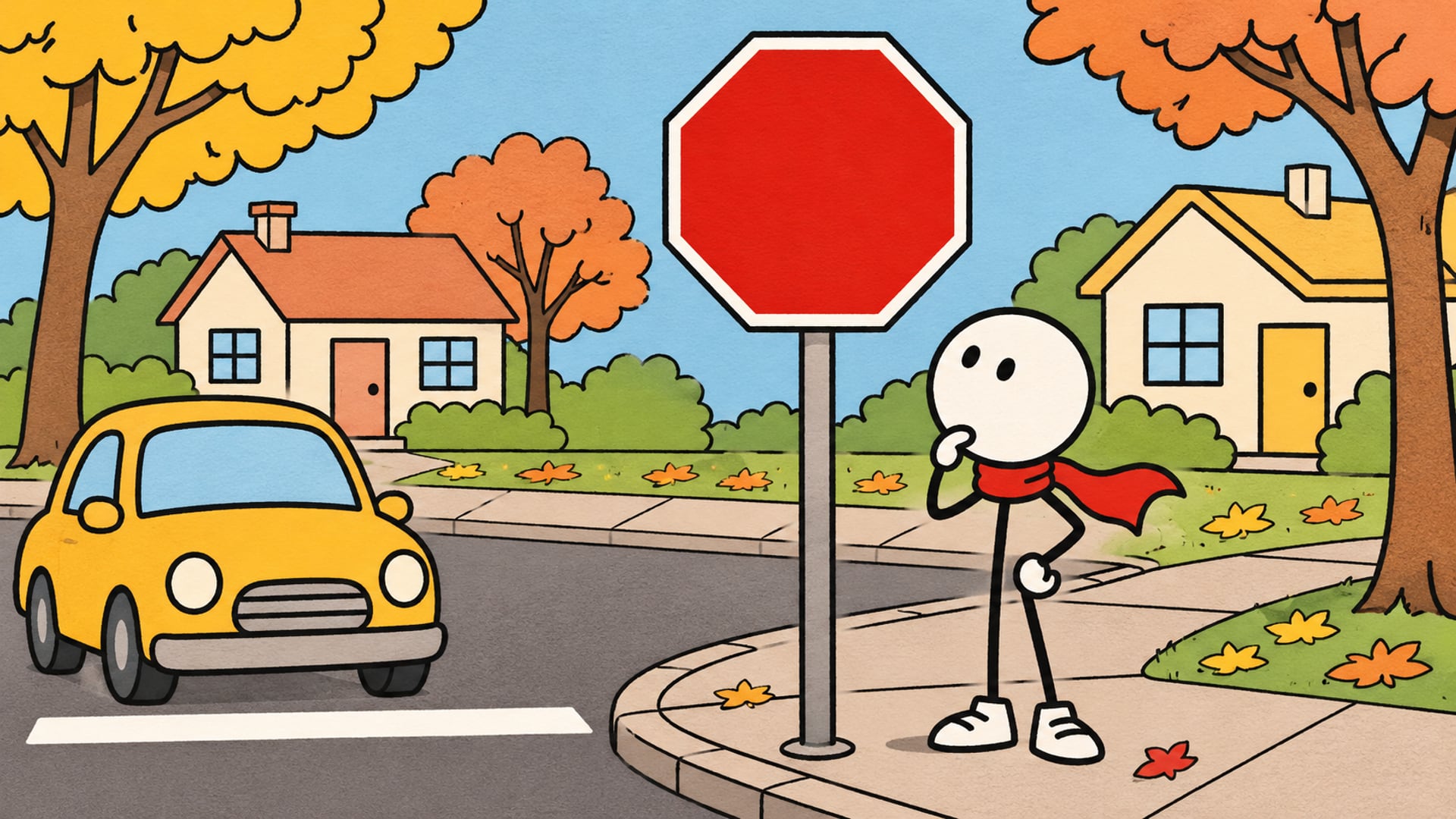
The octagon was meant to let a driver recognize a STOP sign by its outline before reading the word. It was one shape in a 1923 plan that gave every sign type its own shape. Red joined the octagon in 1954, once fade-resistant red finishes could be seen well at night.

In this explainer +
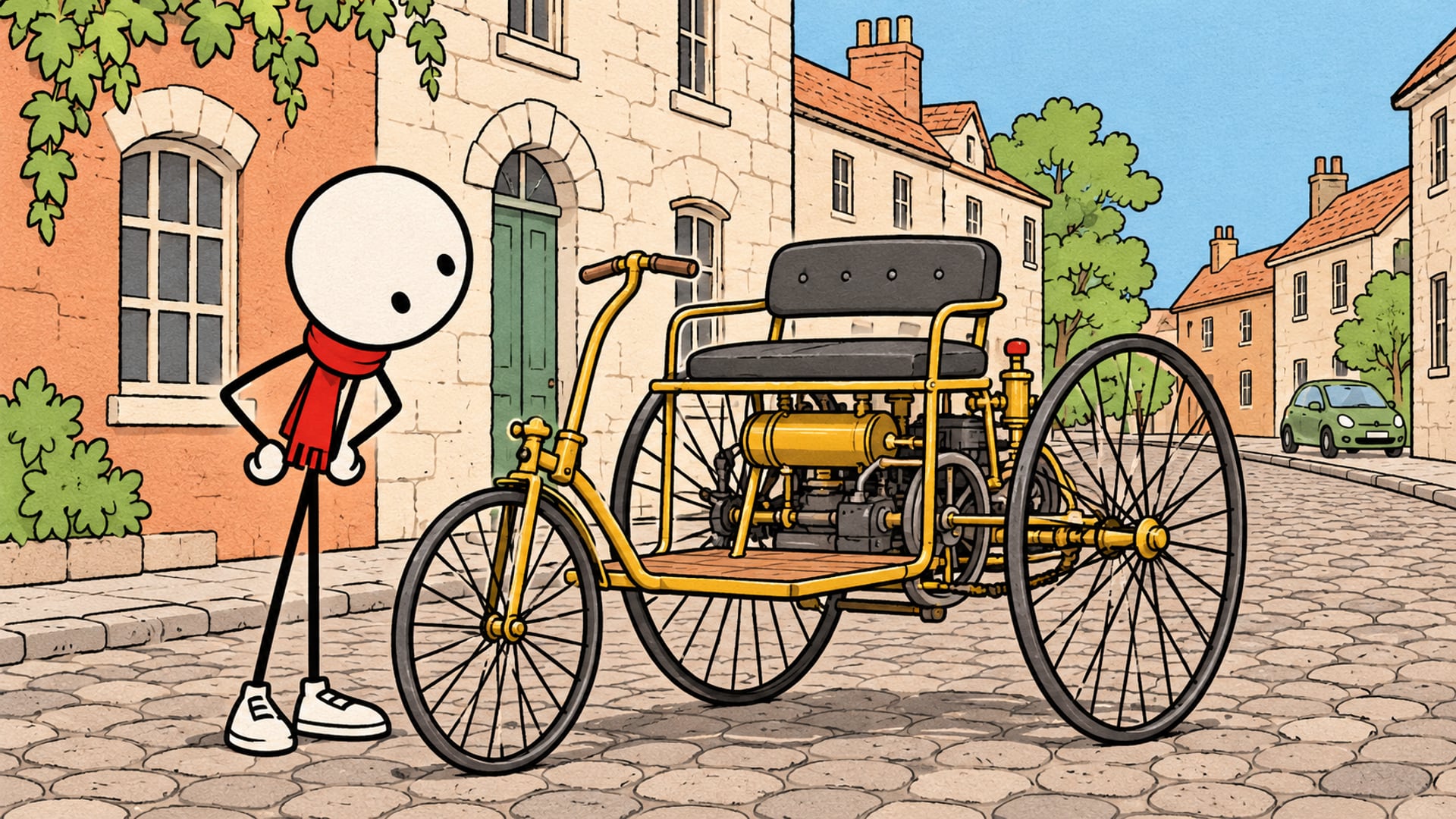
It's 1915 in Detroit, Michigan, and William J. B. Bachman is standing beside an early stop sign on a city street.
The Michigan Department of Transportation credits Bachman with erecting the state's first stop sign. It was a local device, one city's answer to a brand-new problem, not a national standard. Signs of that era varied in shape, size, color and wording.
The eight sides came later. The octagon was meant to let a driver recognize a STOP sign by its shape before reading the word, as part of a 1923 plan that gave each sign shape a meaning, as FHWA's history of road sign numbering tells it.
A manufacturing point shaped the choice too. Round and octagonal blanks wasted the most material when cut, so those shapes went to the sign types expected to need the fewest installations. And the red? That came much later, in 1954.
A shape for every message
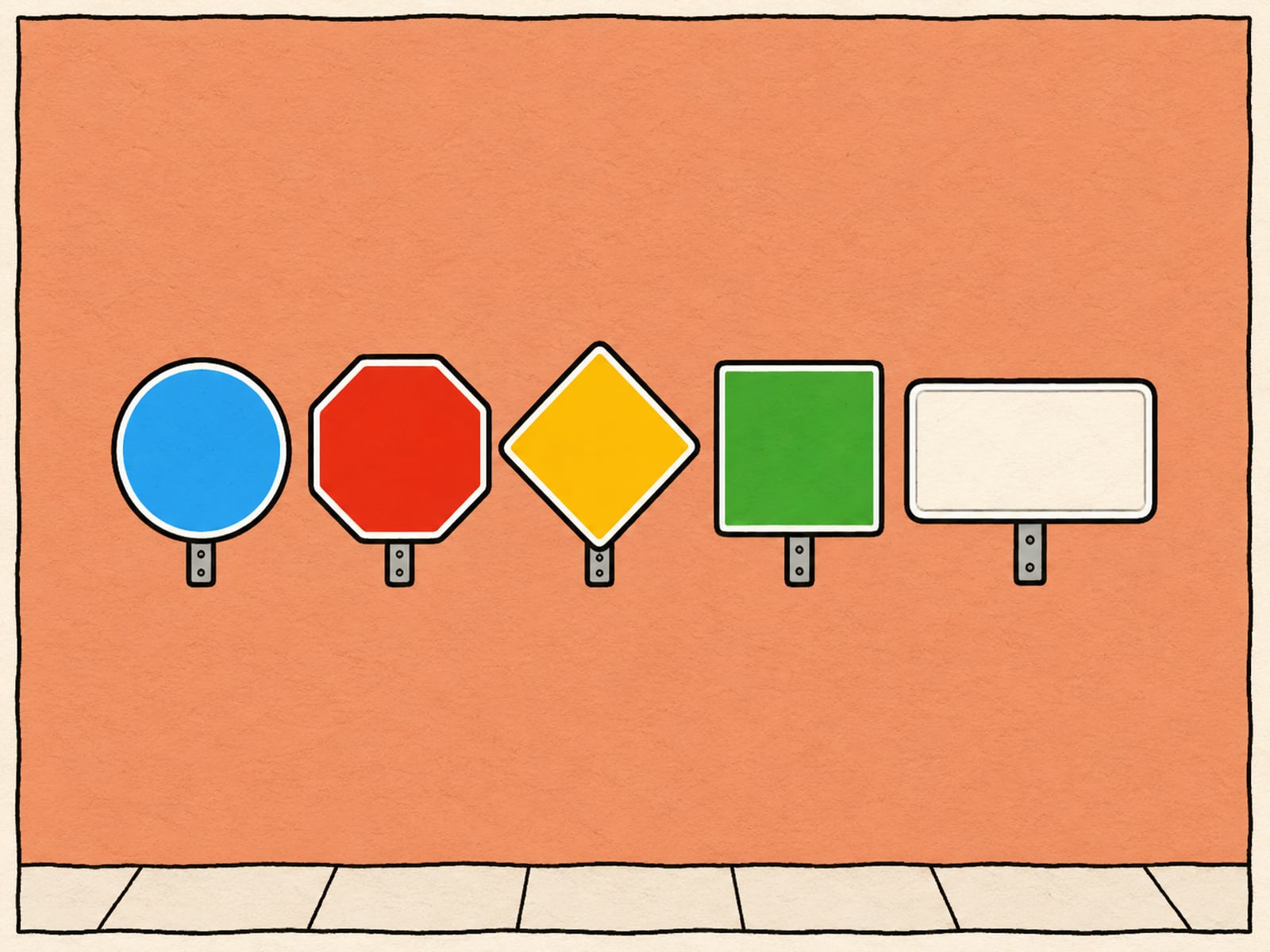
In January 1923, in Chicago, representatives from Wisconsin, Minnesota and Indiana reported a shape system to the Mississippi Valley Association of State Highway Departments. Each shape got a job:
- Round: railroad-crossing warnings
- Octagon: STOP
- Diamond: slow or caution warnings
- Square: attention or caution messages
- Rectangle: directional and regulatory information
The idea was that a shape could carry meaning before a driver could read the words, especially at night. The octagon marked STOP as a more serious danger level than the diamond and square signs. In that proposal the signs were black and white.
Now the catch. Round and octagonal blanks produced the most waste when they were cut, so the plan reserved them for sign categories expected to need the fewest installations. A shape that cost more to make went to the sign that was supposed to be rarer.
The association's plan was later folded into broader national standardization efforts. By 1927, the first national rural road-sign manual showed a black-on-yellow octagonal STOP sign, according to the same FHWA history.
Yellow first, red later
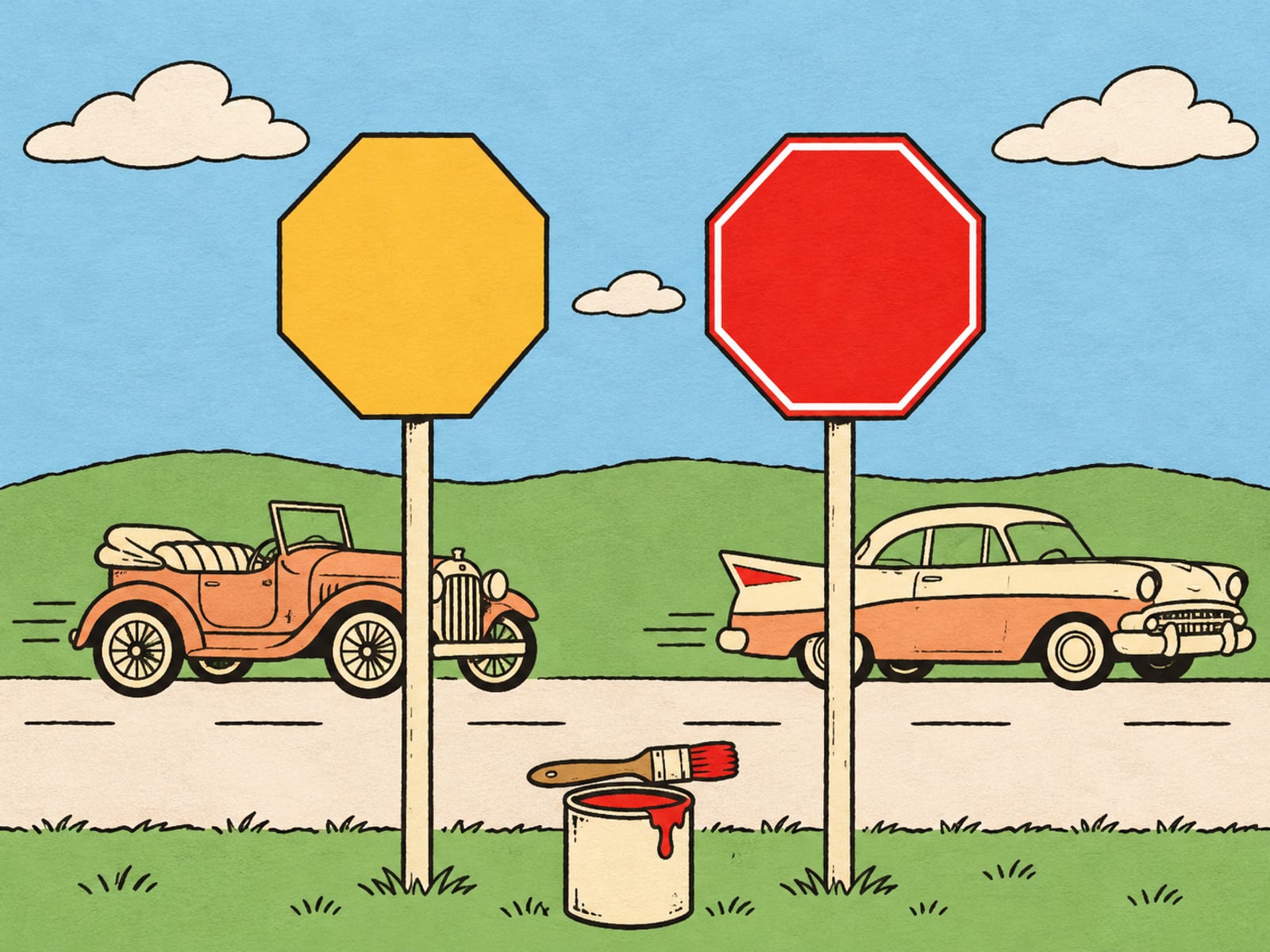
So, why was that 1927 sign yellow? Because in 1924 the American Association of State Highway Officials judged yellow more visible than other colors. The same report rejected red, because red finishes of the time had inadequate nighttime visibility. Yellow became the background for danger and caution signs, STOP included. FHWA lays this out in The Evolution of MUTCD.
The first national MUTCD, the Manual on Uniform Traffic Control Devices, arrived in 1935 and kept the yellow STOP sign.
Then, in 1954, the MUTCD changed it to white letters on a red octagon. FHWA attributes the change mainly to fade-resistant red finishes that also gave better nighttime visibility, as its MUTCD history explains.
In other words, red had to wait for better paint.
The outline still does its job
The national standard today is the FHWA MUTCD 11th Edition with Revision 1, dated December 2025. It identifies STOP as sign R1-1, in Section 2B.04. Figure 2B-1 shows a red octagon with a white border and the white legend STOP, and the MUTCD prohibits secondary legends on the sign. Table 2B-1 gives 30 by 30 inches for a conventional single-lane road, 36 by 36 inches for multilane roads and expressways, and 48 by 48 inches as an oversized option. Those are width by height.
The shape is still the point. FHWA says the octagon is reserved for the STOP message and stays recognizable under most lighting conditions. The outline can even be identified from behind. And when snow, rain, darkness or glare hide the lettering or weaken the color, the outline still signals what the sign is for.
FHWA material on designing roads for an aging population links drivers' comprehension of STOP signs to the unique shape and color combination.
Think of it like this: the outline is a cue that does not depend on reading the word, or on telling red from other colors. It works at a glance.

Not every country uses eight sides
The 1968 Vienna Convention on Road Signs and Signals describes a standard STOP sign as an octagon with a red background and a white inscription, the word STOP or its local equivalent. The United Nations Treaty Series carries the text.
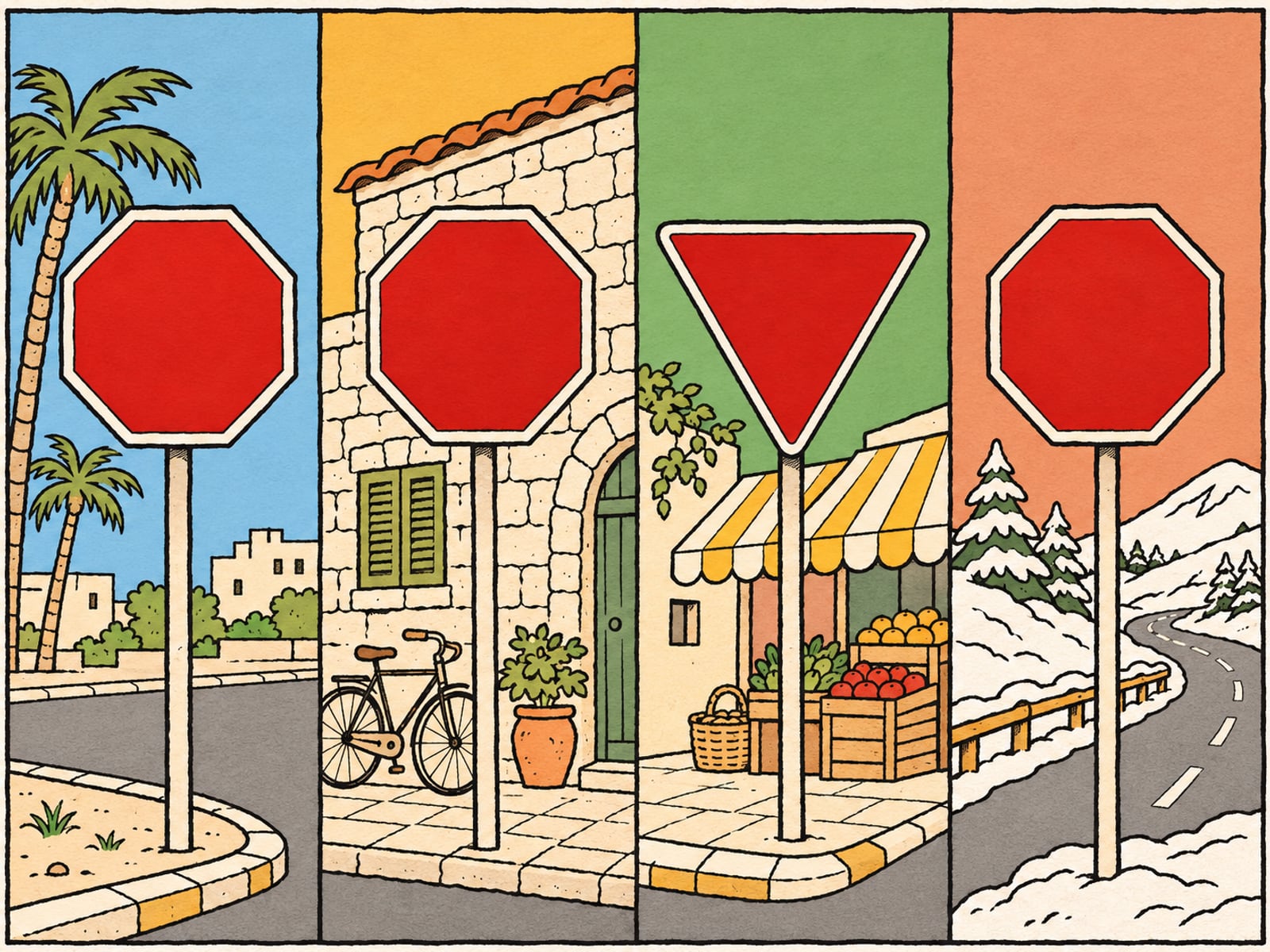
The wording changes from place to place. Mexico uses a red octagon with the word ALTO, under NOM-034-SCT2-2011. Spain uses a red octagon with STOP, the R-2 sign, which means stop at the next stop line or, if there is none, immediately before the intersection, per the Reglamento General de Circulación. The United Kingdom also uses a red octagon with STOP, as the Department for Transport shows.
Japan breaks the pattern. Its stop sign is a red inverted triangle marked with the Japanese word for stop, and some newer signs also show STOP in English, per the National Police Agency. The red octagon is widespread, but not universal.
The record
| Date | What happened | Source |
|---|---|---|
| 1915 | William J. B. Bachman is credited with erecting Michigan's first stop sign in Detroit | MDOT, William J. B. Bachman |
| January 1923 | Representatives from Wisconsin, Minnesota and Indiana report a sign-shape system in Chicago | FHWA, From Names to Numbers |
| 1924 | AASHO judges yellow more visible and rejects red for poor nighttime visibility | FHWA, The Evolution of MUTCD |
| 1927 | A black-on-yellow octagonal STOP sign appears in the first national rural road-sign manual | FHWA, From Names to Numbers |
| 1935 | The first national MUTCD keeps the yellow STOP sign | FHWA, MUTCD 80th birthday history |
| 1954 | The MUTCD changes STOP to white letters on a red octagon | FHWA, MUTCD 80th birthday history |
| 1968 | The Vienna Convention describes a red octagon with a white inscription | United Nations Treaty Series |
| December 2025 | MUTCD 11th Edition with Revision 1 shows the R1-1 red octagon with a white border | FHWA, MUTCD 11th Edition |
Questions people ask
Why are stop signs red? 01
Because of the 1954 MUTCD change. FHWA attributes it mainly to fade-resistant red finishes with better nighttime visibility. Before that, a 1924 report had rejected red because the finishes then available were hard to see at night.
Why do stop signs say STOP in Spain but ALTO in Mexico? 02
Each country sets its own sign standard, and the 1968 Vienna Convention allows the word STOP or its local equivalent on the octagon. Spain's rules call for STOP. Mexico's national standard calls for ALTO.
Why can a driver recognize a stop sign from the back? 03
The octagon is reserved for STOP, and FHWA says the outline can be identified from behind. A driver coming from the other direction sees a silhouette with eight sides and knows what it means, even with no lettering in view.
Why are yield signs triangles? 04
They follow the same thinking as the 1923 plan: give each kind of instruction its own distinctive form. A separate shape system assigns different forms to different right-of-way instructions, so a driver can tell them apart at a glance.
A shape you can read in the dark
The 1915 sign on that Detroit street was one city's answer. The octagon was the country's.
Today the shape is reserved for STOP, so a driver can know the sign in the dark, in snow or from behind. The lettering and the red help, but the outline does the first job.
A stop sign is an octagon so it can be known before it is read.
Sources

- Michigan Department of Transportation, "William J. B. Bachman"
- FHWA, "From Names to Numbers"
- FHWA, "The Evolution of MUTCD"
- FHWA, "MUTCD 80th birthday history"
- FHWA, "MUTCD 11th Edition with Revision 1"
- FHWA, "MUTCD Part 2 with Revision 1, Sections 2B.02 to 2B.04 and Table 2B-1"
- FHWA, "Official interpretation on STOP/SLOW paddle shape"
- FHWA, "Handbook for Designing Roadways for the Aging Population, Chapter 7"
- United Nations Treaty Series, "Road Signs and Signals provisions"
- Mexico, "NOM-034-SCT2-2011"
- Spain, "Reglamento General de Circulación"
- UK Department for Transport, "Regulatory signs"
- Japan National Police Agency, "Road signs and markings"