Why Are Zebras Striped?
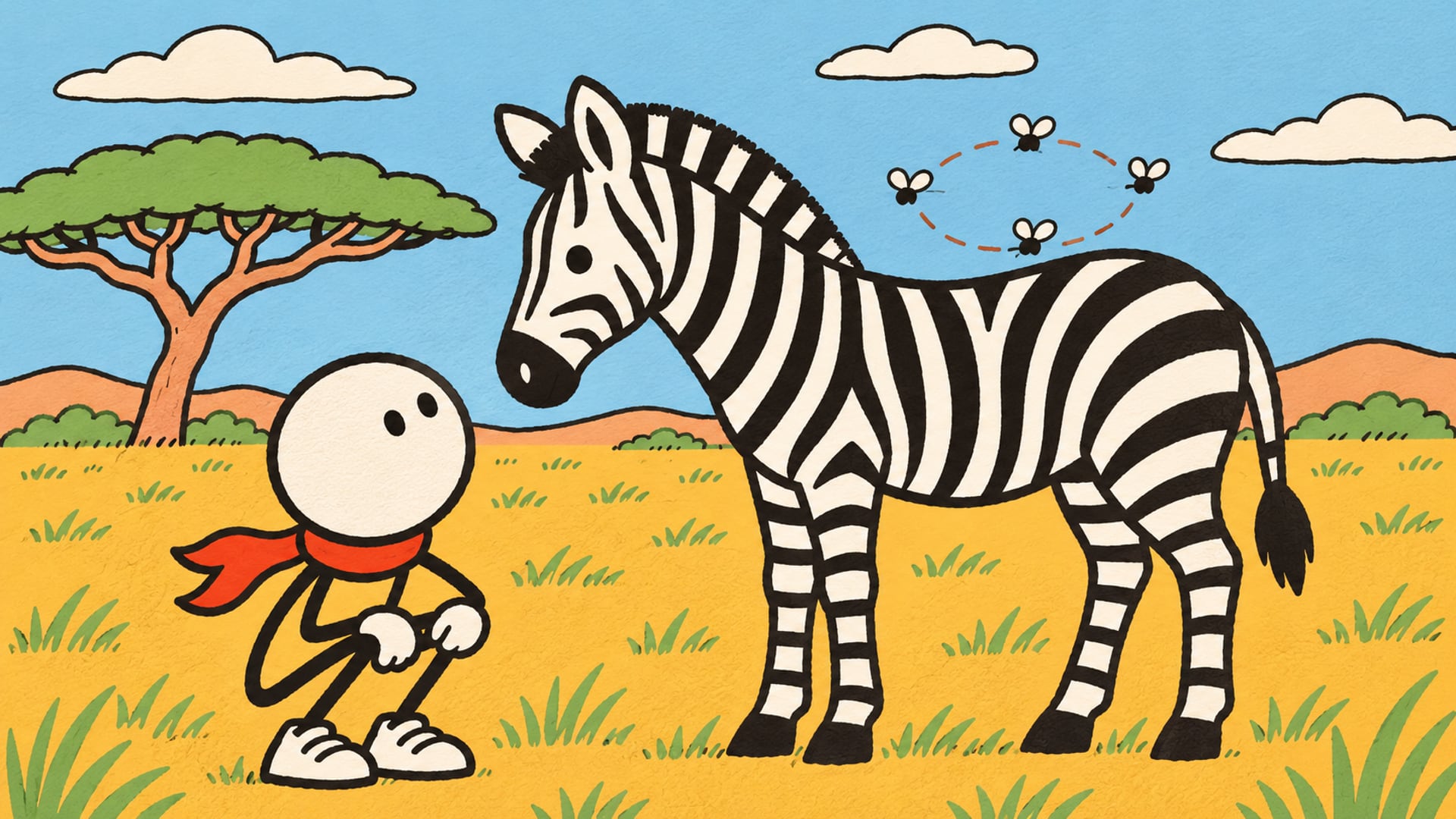
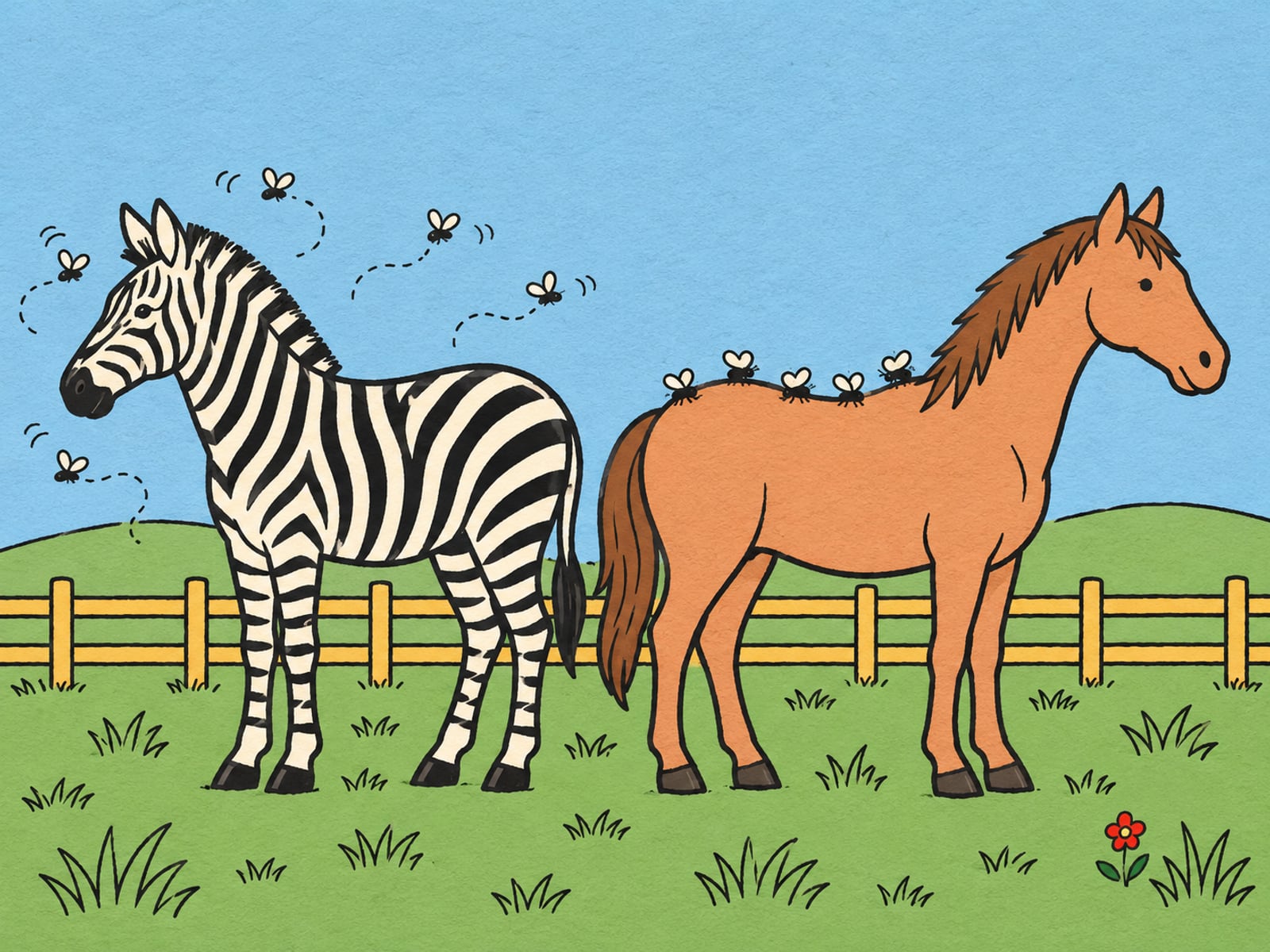
Zebra stripes most likely help keep biting flies from landing. In a 2019 experiment, flies landed on zebras 0.26 times a minute and on horses 1.08 times a minute. That supports stripes as a fly defense, but it does not prove that fly avoidance explains every feature of every stripe.

In this explainer +
The best-supported reason for zebra stripes is biting flies. Stripes seem to make it harder for the flies to land.
That is where the evidence points, and it points there more firmly than it does for any other idea. Tim Caro and his colleagues reported the pattern in a 2014 analysis across African zebra populations, then tested it in a 2019 experiment with horses.
Here is the order we'll take. First, the fly evidence. Second, the ideas that held up less well: camouflage, confusing lions, cooling, and social life. Third, the skin and hair facts. Fourth, the stripes themselves, which turn out to be one of a kind.
1. Flies circle, then fail to land
Start with the 2014 analysis. Caro and colleagues compared zebra striping with the places zebras live. Stripes matched the distribution of biting flies, especially tabanids (horseflies) and tsetse flies, better than they matched camouflage, predators, heat or social factors. The pattern was strongest where biting flies are a burden.
A match on a map is a clue, not a test. So, the team ran a test.
In the 2019 experiment, observers watched three zebras and nine horses at a horse farm in North Somerset, UK. Flies circled both kinds of animal. But they landed on zebras at 0.26 landings per minute, against 1.08 on horses.
Then came the coats. Seven horses wore coats in black, white or stripes. The striped coats drew far fewer touches and landings than the plain black or white ones. The flies still came close to the zebras. They often failed to slow down for a controlled landing, bumped into the coat, or flew away.
In other words, the flies found the zebra. They just couldn't park.
This was not the first hint. In 2012, Susanne Åkesson and colleagues tested black, white and striped horse models against horseflies, and the narrow striped patterns attracted the fewest flies.
One qualification belongs right here. The evidence supports stripes as a defense that reduces successful landings by biting flies. It does not prove that fly avoidance is the only job of every stripe feature.
2. Camouflage, predators, heat and social ideas
Flies are not the only explanation anyone has offered. Each of the other ideas has been put to a test too, and here is what each test showed.
Camouflage. In 2016, Andrew Melin, Douglas Kline, Chihiro Hiramatsu and Caro ran zebra images through the visual systems of lions, spotted hyenas, zebras and humans. At typical distances, the predators could not resolve the stripes. At closer range the pattern stood out. That makes anti-predator camouflage unlikely.
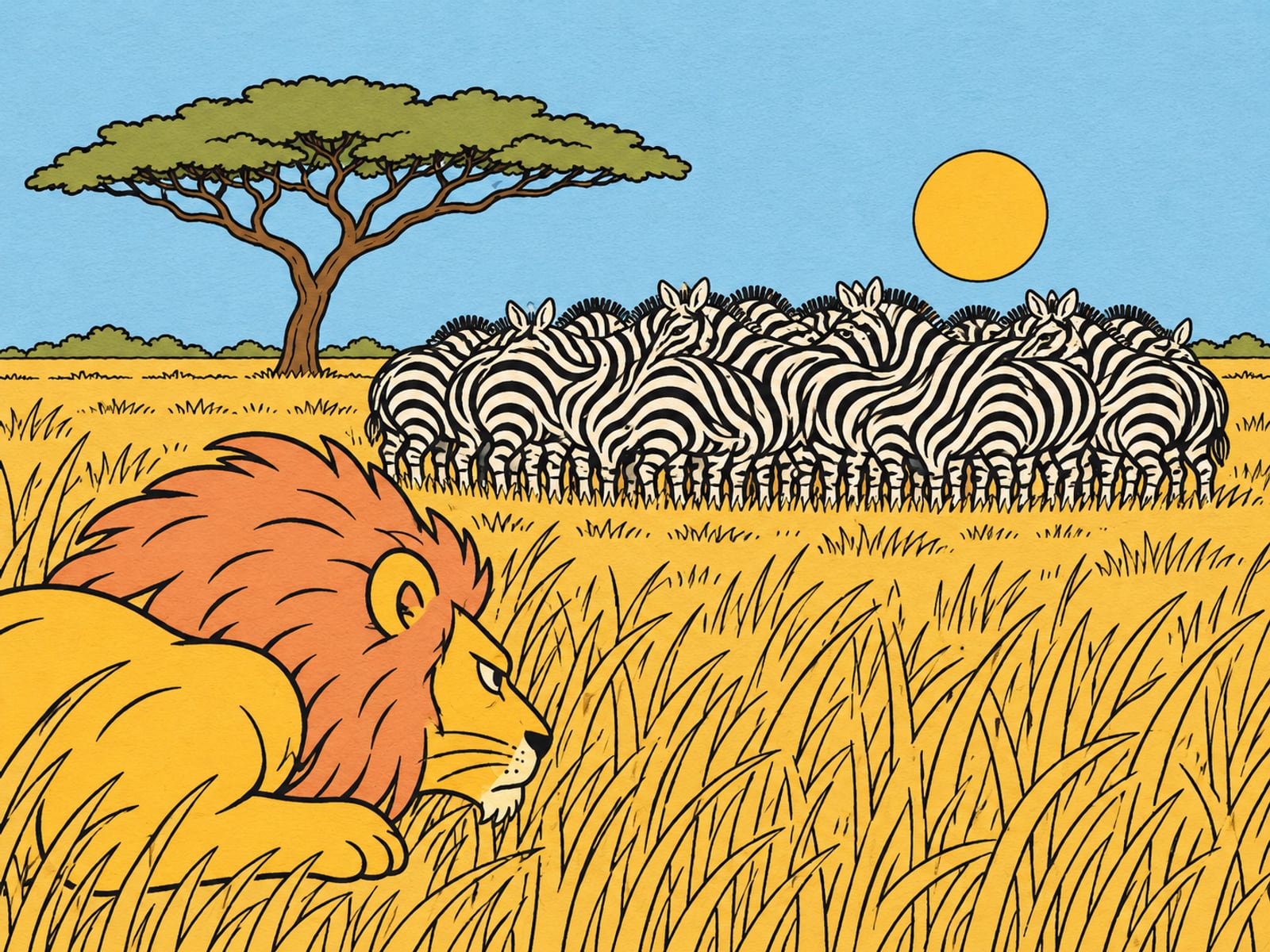
Confusing predators. The idea is that a lion can't pick one zebra out of a moving blur of stripes. Caro's 2014 analysis found no consistent link between striping and the presence of large predators. The 2019 paper also says zebra striping does not have the pattern you would expect if it were meant to confuse predators.
Heat. One proposal says black and white stripes set up air currents that cool the body. In 2017, Gábor Horváth and colleagues covered water-filled barrels with zebra, horse, cattle, grey, black, white and striped materials in Göd, Hungary. Published in 2018, the barrel experiment found no significant core-temperature difference between striped and comparable grey coverings, including on hot days.
Social life. Zebras can recognize each other by pattern. But Caro's comparative work found no consistent evidence that stripes are needed for recognition, grooming or mate choice. Horses and other unstriped equids form groups and recognize individuals too.
None of these ideas is ruled out as a small or secondary role. The evidence for them is just weaker and less consistent than the evidence for flies.
3. Black skin, black and white hair
Now a quieter question. Is a zebra a black animal with white stripes, or a white one with black stripes?
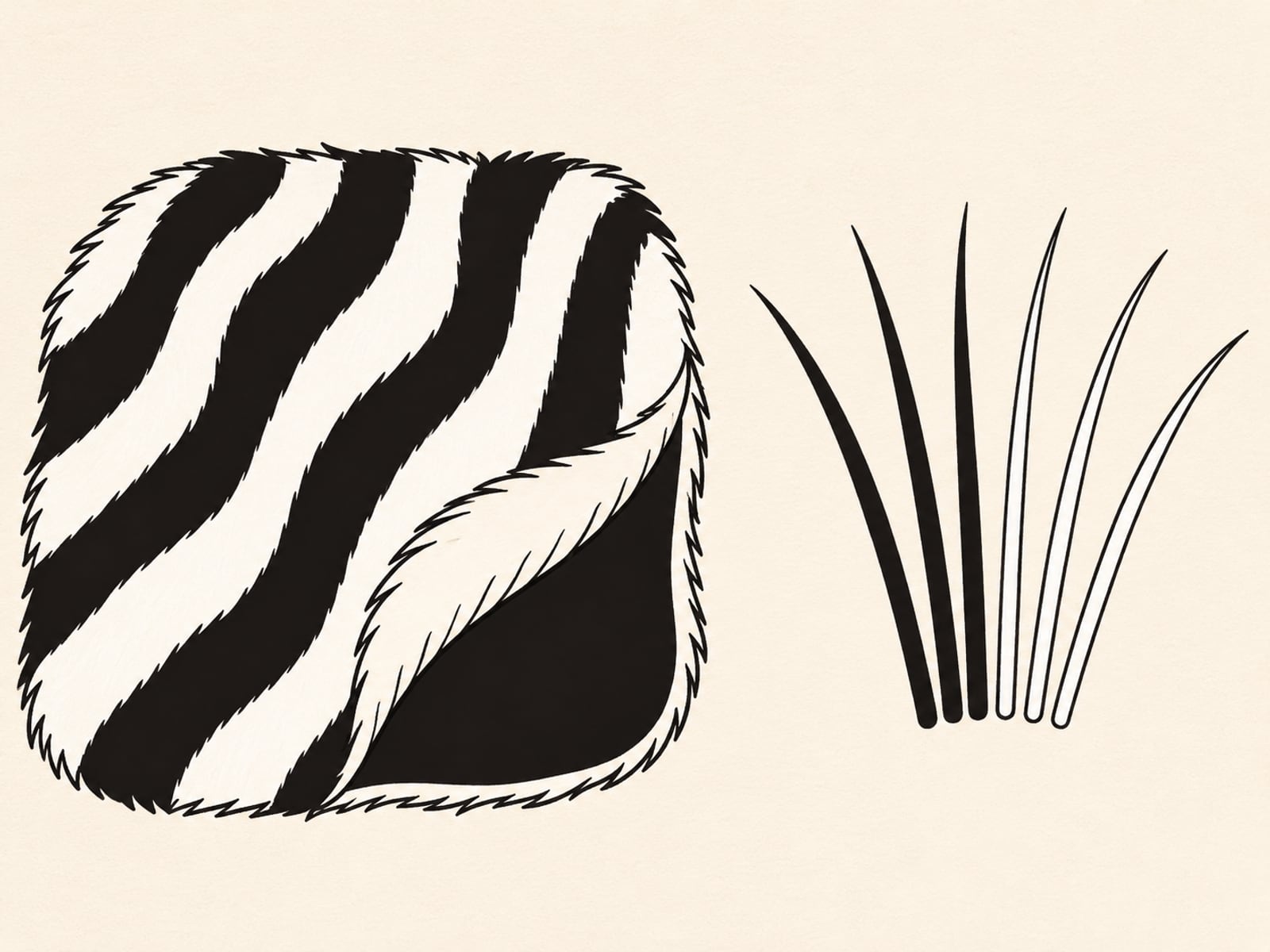
A zebra has black skin and both black and white hair. Black hairs contain melanin, the pigment that darkens skin and hair. White hairs form where pigment production is switched off in the hair follicles, the tiny pockets the hairs grow from. The Tech Interactive's Ask a Geneticist column covers this.
In that developmental sense, people commonly call zebras black animals with white stripes. The safest description is a black-and-white striped coat.
One more detail. "Black with white stripes" describes the hair. The skin underneath can differ from the pattern you see on top, so it isn't a claim that every patch of skin is black beneath every white hair.
4. Each zebra carries its own pattern
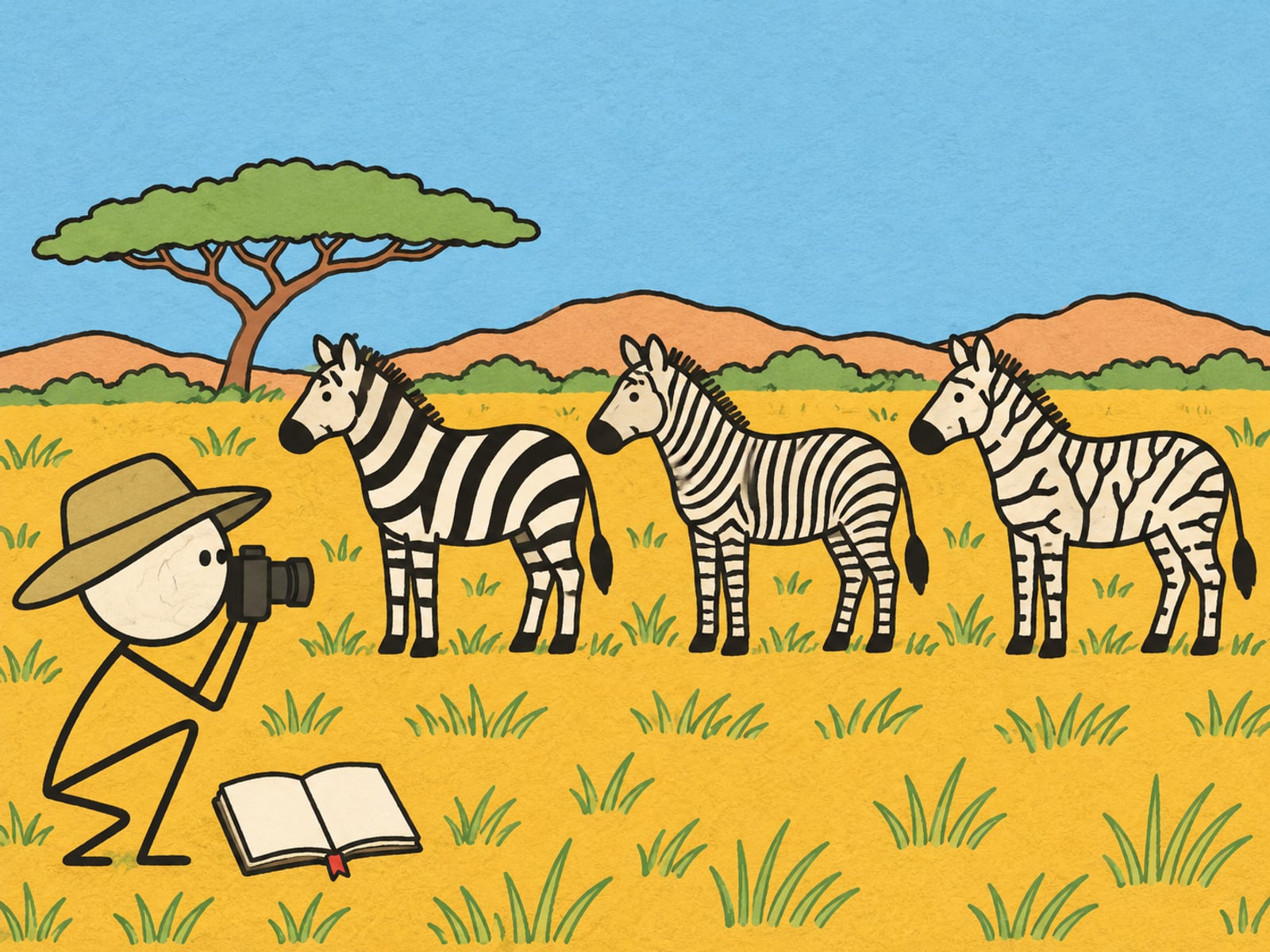
Stripe patterns differ from one zebra to the next. They are distinctive enough that researchers use photographs as identification marks, much like a biometric signature. The Natural History Museum's Rainbow nature feature describes the idea, and a study of stripe uniqueness by Prinsloo, Postma and de Bruyn at the University of Pretoria looks at it in detail.
With a good photo, researchers can follow the same zebra across repeated field observations. They can track births, survival, movements, herd membership and social relationships. They can also build photo databases and train computer-vision systems to spot individuals.
That last part is still a work in progress. A 2022 University of Bristol study on Grevy's zebras tested 3D fitting and machine learning on a small dataset. Identification accuracy rose from 48.0% to 56.8%. Useful, and also a sign that automated identification still has limits.
The record
Here are the dated moments behind the story, in time order.
| Date | What happened | Source |
|---|---|---|
| 2012 | Susanne Åkesson and colleagues test black, white and striped horse models; narrow stripes attract the fewest horseflies | RTVE |
| 2014 | Tim Caro and colleagues compare zebra striping with environmental variables across African zebra populations | Nature Communications |
| 2016 | Melin, Kline, Hiramatsu and Caro process zebra images through predator-vision models | PLOS ONE |
| 2016 and 2017 | Caro's team observes three zebras and nine horses in North Somerset, UK, recording flies circling, touching and landing | PLOS ONE |
| 2017 | Horváth and colleagues test covered water barrels in Göd, Hungary | Scientific Reports |
| 2016 to 2017 | Seven horses wear black, white or striped coats in randomized order; striped coats draw far fewer landings | PLOS ONE |
| 2022 | University of Bristol study on Grevy's zebra identification reaches 56.8% accuracy on a small dataset | University of Bristol |
Questions people ask
Why don't flies land as often on zebras? 01
It comes down to the final approach. High-speed video showed flies reaching zebras but failing to slow down for a controlled landing. The stripes disrupt that last moment, so the fly bumps the coat or veers off.
Why do zebras have black and white stripes? 02
The stripes are hair pigmentation. Melanin is made in the black hairs and is absent from the white ones.
Why don't lions get confused by a herd of zebras? 03
Lions' vision, viewing distance, movement and field evidence all matter here. Caro's 2014 analysis found no consistent link between striping and large predators, so strong predator confusion is not the best-supported explanation.
Why are zebra stripes different from one animal to another? 04
Individual development and genetic variation shape where each stripe sits, how wide it is, how it branches and how much contrast it has. Those small differences add up to a pattern no other zebra shares.
Stripes worth keeping
A zebra's stripes most likely help keep biting flies off. The flies still arrive, and they still circle. They just fail to land.
The same coat also works as a name tag. A researcher with a camera can tell one zebra from another by the pattern alone.
The stripes most likely keep biting flies off a zebra, and each zebra wears its own pattern.
Sources

- Caro et al., "The function of zebra stripes," Nature Communications, 2014
- Caro et al., "Benefits of zebra stripes: Behaviour of tabanid flies around zebras and horses," PLOS ONE, 2019
- RTVE, "Las cebras desarrollaron su piel rayada para espantar a las moscas"
- Melin et al., "Zebra Stripes through the Eyes of Their Predators, Zebras, and Humans," PLOS ONE, 2016
- Horváth et al., "Experimental evidence that stripes do not cool zebras," Scientific Reports, 2018
- Caro, "Intraspecific communication," University of Chicago Press
- The Tech Interactive, "Why do zebras have two different colors?"
- Natural History Museum, "Rainbow nature: life in bold black and white"
- Prinsloo, Postma and de Bruyn, "How unique is unique?", 2021
- Stennett, Rubenstein and Burghardt, "Towards Individual Grevy's Zebra Identification via Deep 3D Fitting and Metric Learning," University of Bristol, 2022