Why Do Geese Fly in a V?
Geese fly in a V mainly to save energy. A bird behind and to one side of another can use the upward-moving air off the leader's wingtip, which lowers the power it needs to fly. Keeping sight of each other and letting young birds follow experienced ones are proposed extra benefits.

In this explainer +
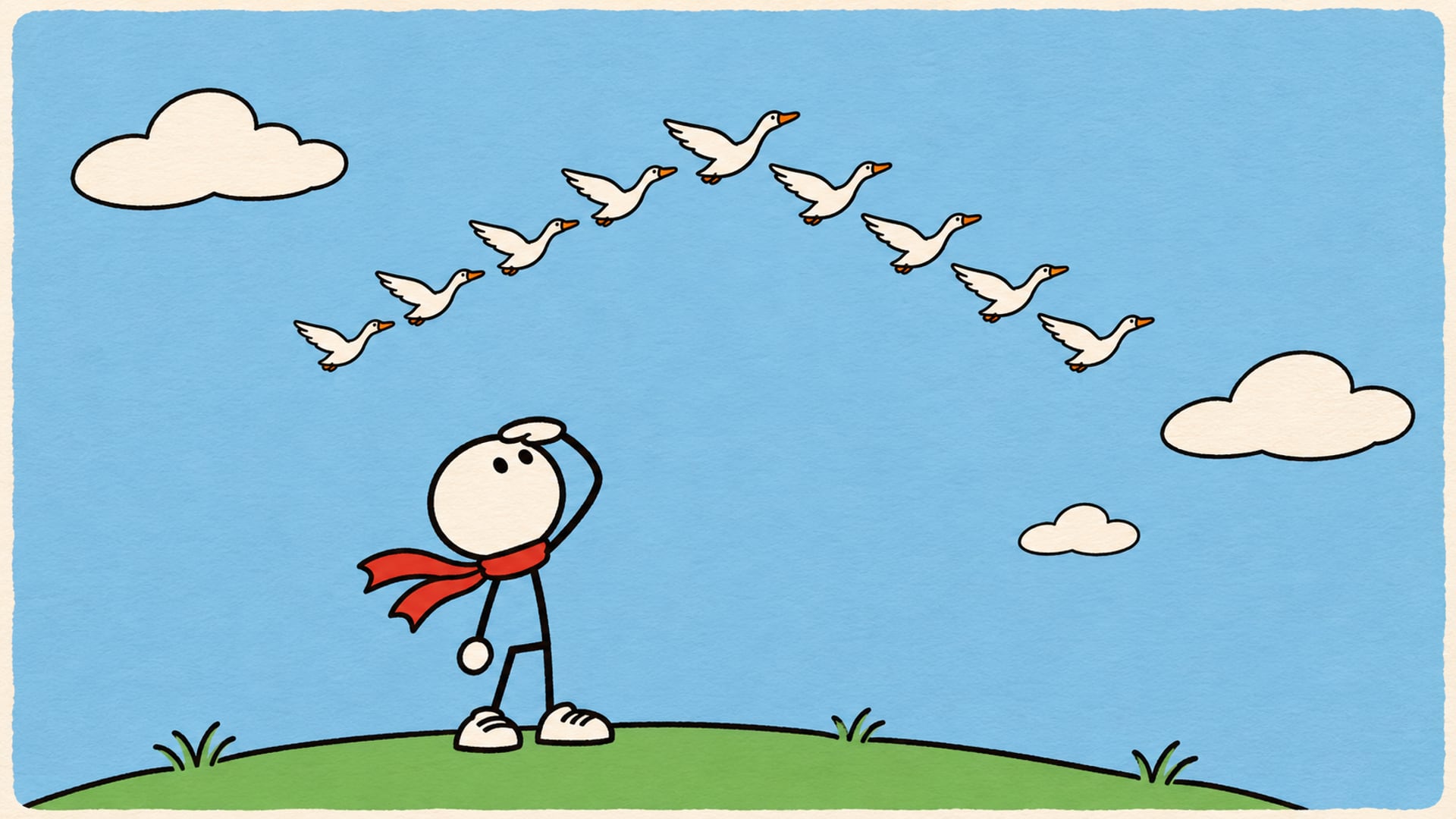
You look up, and a V of geese is crossing the sky. You watch the bird at the point, the one that seems to be working hardest, while the rest slide along behind it in a neat line.
Then you ask the obvious thing: why that shape?
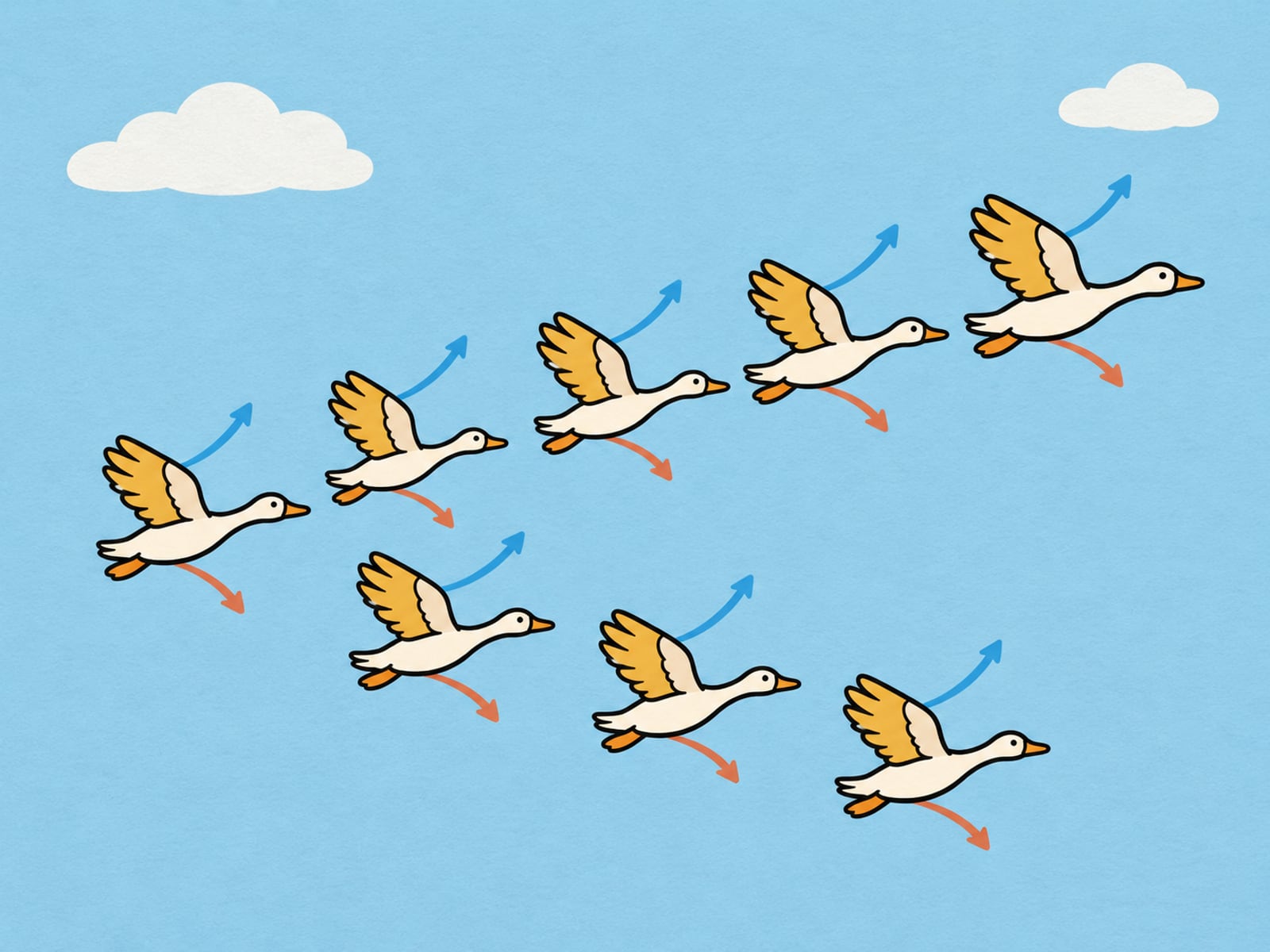
The best-supported reason is energy. A bird flying just behind and to the side of another can use the rising air, called upwash, that comes off the wingtip ahead, and that lowers the power it needs to stay up. In other words, the bird behind is riding rising air that the bird ahead has pushed up off its wingtip.
The key measurements come with a catch, and it's a fun one. They were made on a different bird entirely.
The air a bird leaves behind
Every flying bird stirs the air. Near the outer edge of each wing, the air gets pushed upward. Directly behind the bird, it gets pushed downward. The upward part is the upwash. The downward part is the downwash.
Think of it like this: a boat leaves a wake, and a surfer can ride it. A bird leaves a wake too, except this one is made of air, and the follower is not surfing for fun. It is surfing to spend less power holding its own weight up.
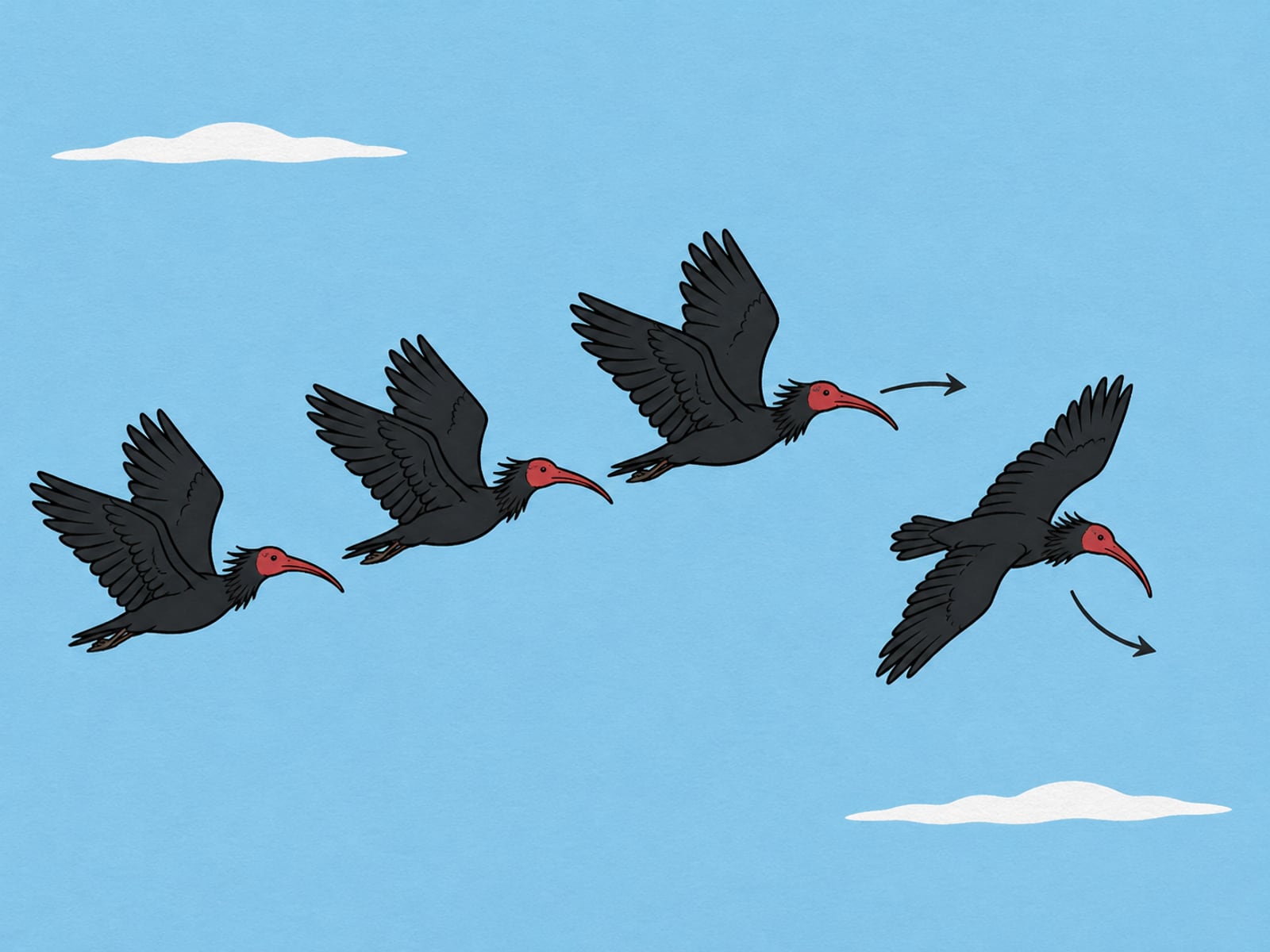
So, the V is a seating chart. Each bird sits where the rising part of the wake is. A bird directly behind another one flaps in near-opposite phase, which may help it dodge the harmful downwash. And birds in the V coordinate their wingbeats so their wingtips follow the useful part of the wake ahead.
What the 2014 study actually measured
The study is Portugal, Hubel, Fritz and colleagues, published in Nature in 2014. It did not use geese. It used 14 juvenile northern bald ibises.
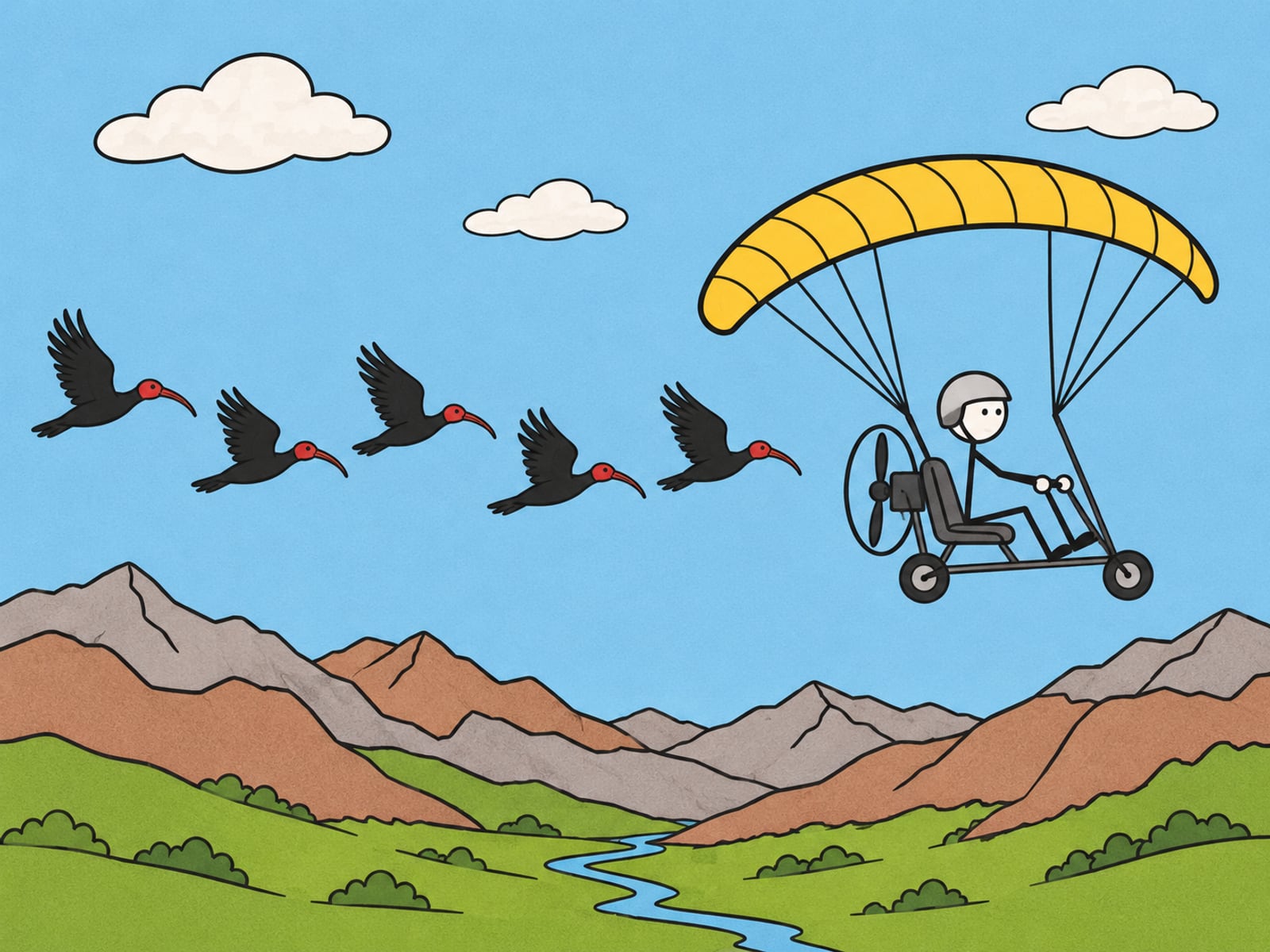
The ibises were hand-reared at Zoo Vienna and guided on migration by a powered paraplane, a small engine-driven aircraft that flew ahead of the flock. Each ibis carried a GPS logger recording its position at 5 Hz and a motion sensor recording its movement at 300 Hz. In plain terms, that is five position readings and 300 movement readings every second.
The result: birds in V positions matched their wingtip paths and their wingbeat timing with the upwash.
That is a measured result on ibises. The study did not measure a percentage of energy saved by geese. For geese, the upwash idea is the explanation on offer, and it is a well-supported one, because the mechanism is the same airflow. It is just not a goose measurement.
Follow-up questions
A few questions come right after the first one. Here they are, one at a time.
1. Do the birds take turns at the front?
The front position is the costly one, since nobody ahead has stirred the air for you. In a 2015 PNAS study by Bernhard Voelkl, Steven Portugal and colleagues, juvenile ibises on a human-guided autumn migration switched leading positions in pairs. The time an ibis spent leading was strongly tied to the time it later spent in another bird's wake. Fair trade, in feathers.
Again, that is ibises. One study of goose family groups, in the Journal of Avian Biology, reported that one parent stayed in front at all times in the observed formations. Other observations describe leadership changes. So, for geese, turn-taking depends on the group.
2. Is energy the only reason?
No. The U.S. Fish and Wildlife Service says the V is easy for birds to monitor as a group and may help communication and coordination. A Mexican bird-observation manual from Casa Chihuahua gives two main explanations: saving energy, and keeping visual contact to avoid collisions.
The Wildfowl and Wetlands Trust adds that the V lets younger geese follow experienced birds and learn migration routes. These are supporting explanations. The aerodynamic evidence is the strongest piece, and the others describe why staying together is useful.
3. Do airplanes do the same thing?
They have been tried. NASA's modeling reported up to 35 percent induced-drag savings for an aircraft following 30 wingspans downstream in trimmed transonic flight. Induced drag is the drag that comes from making lift. That number is an aircraft result, not a goose measurement.
Then came a real flight. On 9 November 2021, two Airbus A350 test aircraft flew from Toulouse, France, to Montreal, Canada, about three kilometers apart. Airbus says the follower used the leader's wake updraft, the flight saved more than six tons of carbon dioxide, and the project was inspired partly by migrating geese.
4. How far do the geese actually go?
It varies by population. The Minnesota Department of Natural Resources says Canada geese sometimes fly as far as 4,000 miles in V-shaped flocks. Colorado Parks and Wildlife says migratory Canada geese winter in Texas, southern California and sometimes parts of Mexico.
So, yes, some reach Mexico. Not every population does, and some Canada geese stay in one area all year.
The record
| Date | What happened | Source |
|---|---|---|
| 2011 | Hand-reared northern bald ibises follow a powered paraplane on migration from Austria. | Europa Press |
| 2011 | Small data loggers on the ibises' backs record each bird's position and wing movements. | Portugal et al., Nature |
| 2014 | Nature study: birds in V positions match wingtip paths and wingbeat timing with the upwash. | Portugal et al., Nature |
| 2015 | PNAS study: juvenile ibises swap leading positions, and time spent leading is tied to time spent in a wake. | Voelkl et al., PNAS |
| 9 November 2021 | Two Airbus A350 test aircraft fly Toulouse to Montreal about three kilometers apart. | Airbus |
| 11 September 2023 | Pink-footed geese arrive at WWT Martin Mere in Lancashire from Iceland in V-shaped family flocks. | WWT Martin Mere |
Questions people ask
Why do birds fly in a V? 01
Mostly for energy and for contact. A following bird can use the upwash from the bird ahead, and the shape lets birds see their neighbors and keep alignment. A 2024 article in the Spanish outlet 20minutos names geese, ducks, swans, pelicans, flamingos, cormorants and ibises among V flyers.
Why do geese honk while they fly? 02
Calls help flock members keep contact and coordinate movement. The exact use of honking varies by species, so treat it as a flock-contact tool rather than a single-purpose signal.
How do geese know where to go? 03
The explanations on offer include learned routes, family guidance, landscape features, celestial cues and possibly magnetic sensing. Young birds that fly with experienced ones can pick up the route as they go.
Why do young geese fly behind older birds? 04
Two things line up. The trailing spots are the energy-saving ones, and the older birds know the way. The WWT describes the V as a way for younger geese to follow experienced birds, and goose family groups travel together.
One wake, three kinds of wings
Ibises, geese and now airliners all lean on the same trick: let the one ahead do the lifting of the air, then slide into the part of it that pushes back up. For migrating Canada geese, that can add up over trips of up to 4,000 miles.
So, the next time you see a V cross the sky, you know what the follower is doing. The bird behind is riding rising air that the bird ahead has pushed up off its wingtip.
Sources

- Portugal, Hubel, Fritz et al., Nature, 2014
- Voelkl, Portugal et al., PNAS, 2015
- PubMed record for the 2015 PNAS study
- Journal of Avian Biology, goose family groups and the V
- U.S. Fish and Wildlife Service, Junior Duck Stamp curriculum
- Wildfowl and Wetlands Trust, why geese fly in V formation
- Casa Chihuahua, Manual del observador de aves
- NASA, Modeling Extended Formation Flight on High-Performance Computers
- Airbus, fello'fly transatlantic flight press release
- Minnesota Department of Natural Resources, Canada goose
- Colorado Parks and Wildlife, Canada Goose
- WWT Martin Mere, pink-footed geese arrive
- 20minutos, El motivo por el que las aves vuelan en forma de V
- Europa Press, Las aves migratorias vuelan en formación para maximizar la eficiencia energética