Why Does the Moon Have Phases?
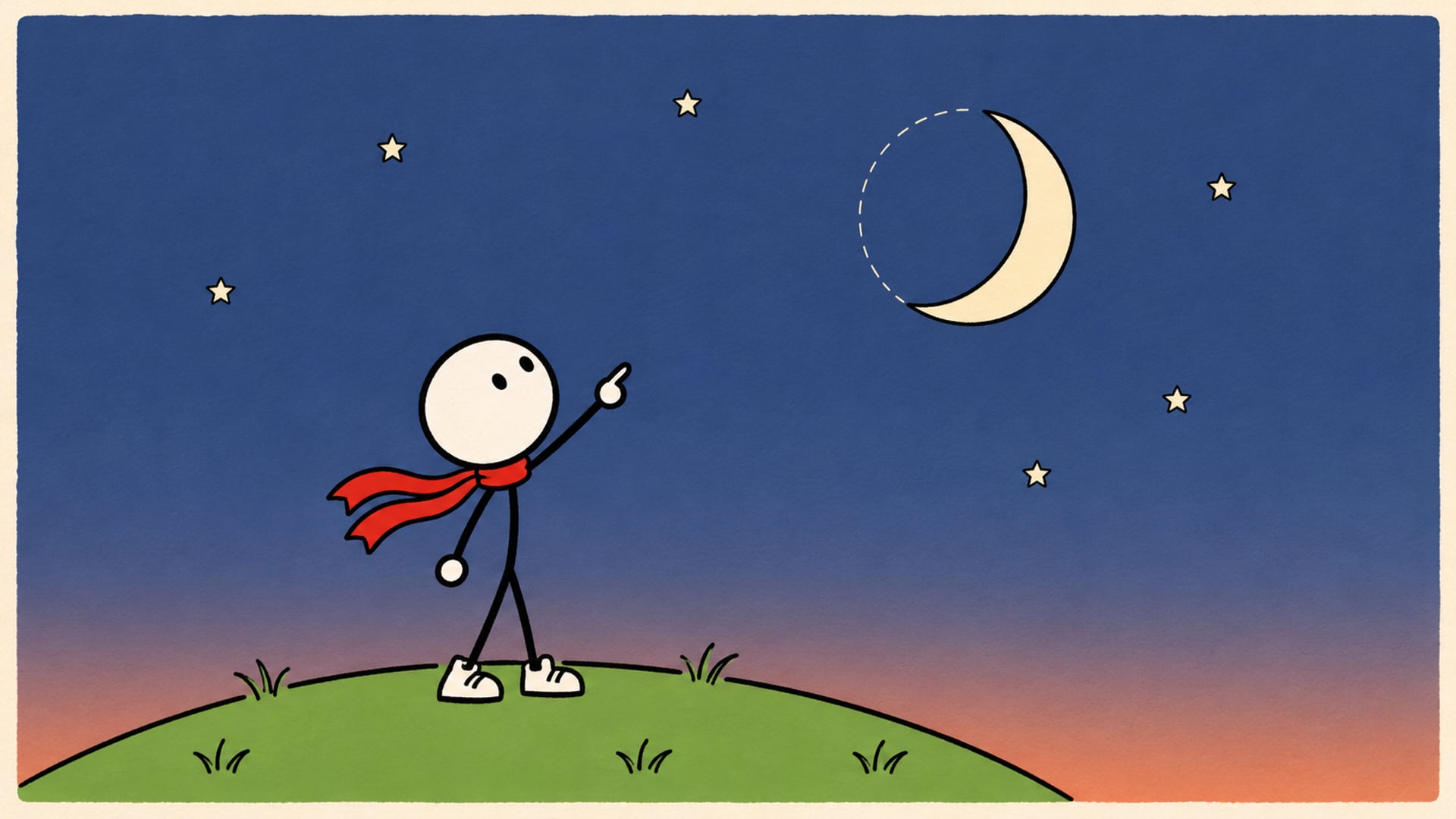
The Moon makes no light of its own. The Sun always lights half of it, and as the Moon orbits Earth we see more or less of that lit half. The cycle repeats about every 29.5 days. Earth's shadow is not the cause of the phases; it reaches the Moon only during a lunar eclipse.

In this explainer +
Next clear night, look up at the Moon and find the lit side. Then climb three steps. Step one: the Sun always lights one half of the Moon. Step two: the Moon travels around Earth. Step three: from Earth, we see a different amount of that lit half as the Moon goes.
So, why is it a full circle one week and a thin curve the next? The answer, in one sentence: the Moon has phases because the Sun always lights half of it, and as the Moon orbits Earth we see different amounts of that sunlit half. NASA Science lays it out the same way.
One limit, right away. Phases come from the angle at which we view the lit half, not from Earth's shadow. Earth's shadow reaches the Moon only in a lunar eclipse, and NASA's eclipse page explains why that is rare.
A lamp, a ball and you
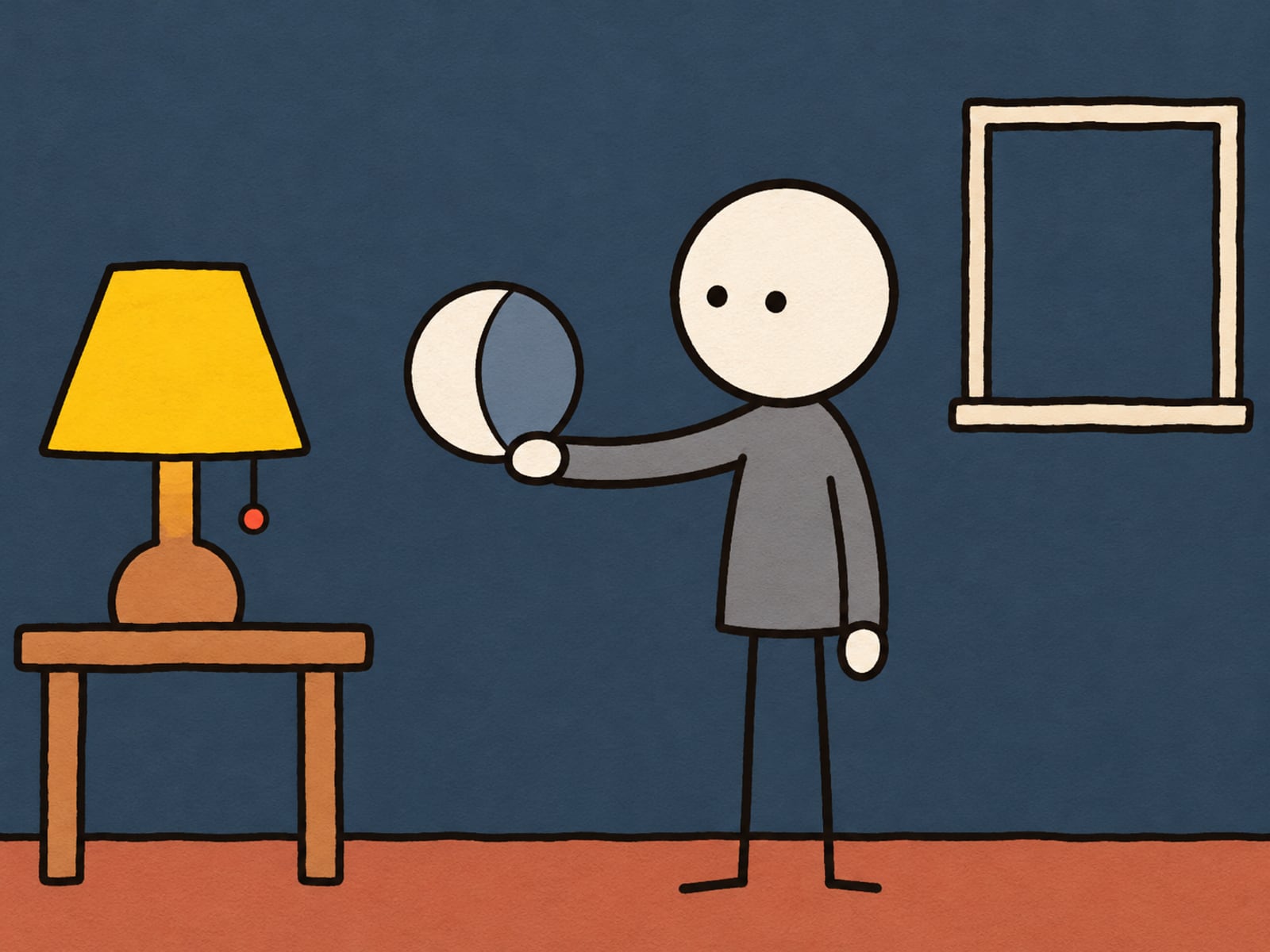
Think of it like this: a lamp, a ball and an observer. Put the lamp on one side of a dark room. Hold the ball out in front of you and turn slowly in a circle, keeping your eyes on it.
The lamp always lights one half of the ball. That never changes. What changes is where you stand relative to the lamp and the ball, and so how much of the lit half faces you. This is the setup in a Spanish-language astronomy guide from UNAWE, which cites the Centro de Investigaciones de Astronomía Francisco José Duarte in Caracas, Venezuela. Its point is that the phase you see depends on where the Sun, the Moon and the observer sit relative to one another.
Now swap in the real thing. The lamp is the Sun. The ball is the Moon. You are on Earth, and Earth carries you along while the Moon circles around you.
The phases in order
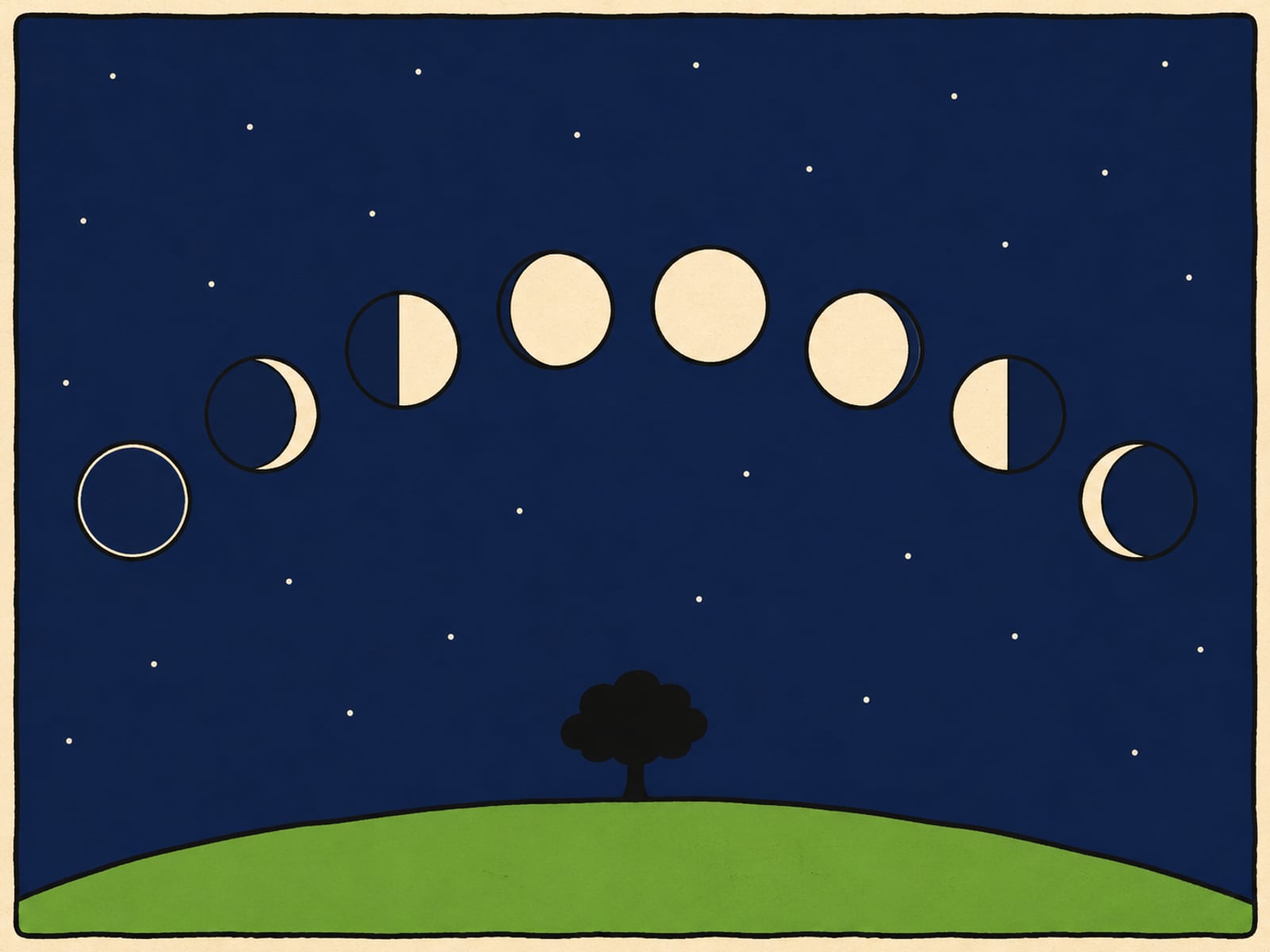
Take one trip around, following NASA's Moon Phases page. The Moon starts at new and ends at new.
New Moon. The Moon sits between the Sun and Earth. The side facing us is mostly dark, so the Moon is hard to see against the daytime sky.
Waxing crescent. A thin curve appears just after sunset. The Moon has moved far enough along its orbit for a small slice of its sunlit side to face us.
First quarter. Half of the visible disk is lit. The Moon is about one quarter of the way through its cycle.
Waxing gibbous. More than half of the visible disk is bright, and the Moon seems to grow as its orbit brings more of the lit half into view.
Full Moon. Earth sits roughly between the Sun and the Moon, and the Earth-facing side is almost fully lit. The full Moon rises around sunset.
Waning gibbous. The bright part starts to shrink, and the Moon rises later each night.
Third quarter. Half the disk is lit again, but it is the opposite half from first quarter. Some people call this the last quarter.
Waning crescent. Only a thin curve is left before the Moon returns to new.
That's one lap of about 29.5 days. Nothing was added or taken away from the Moon along the way. We just kept changing our angle.
Where Earth's shadow does come in
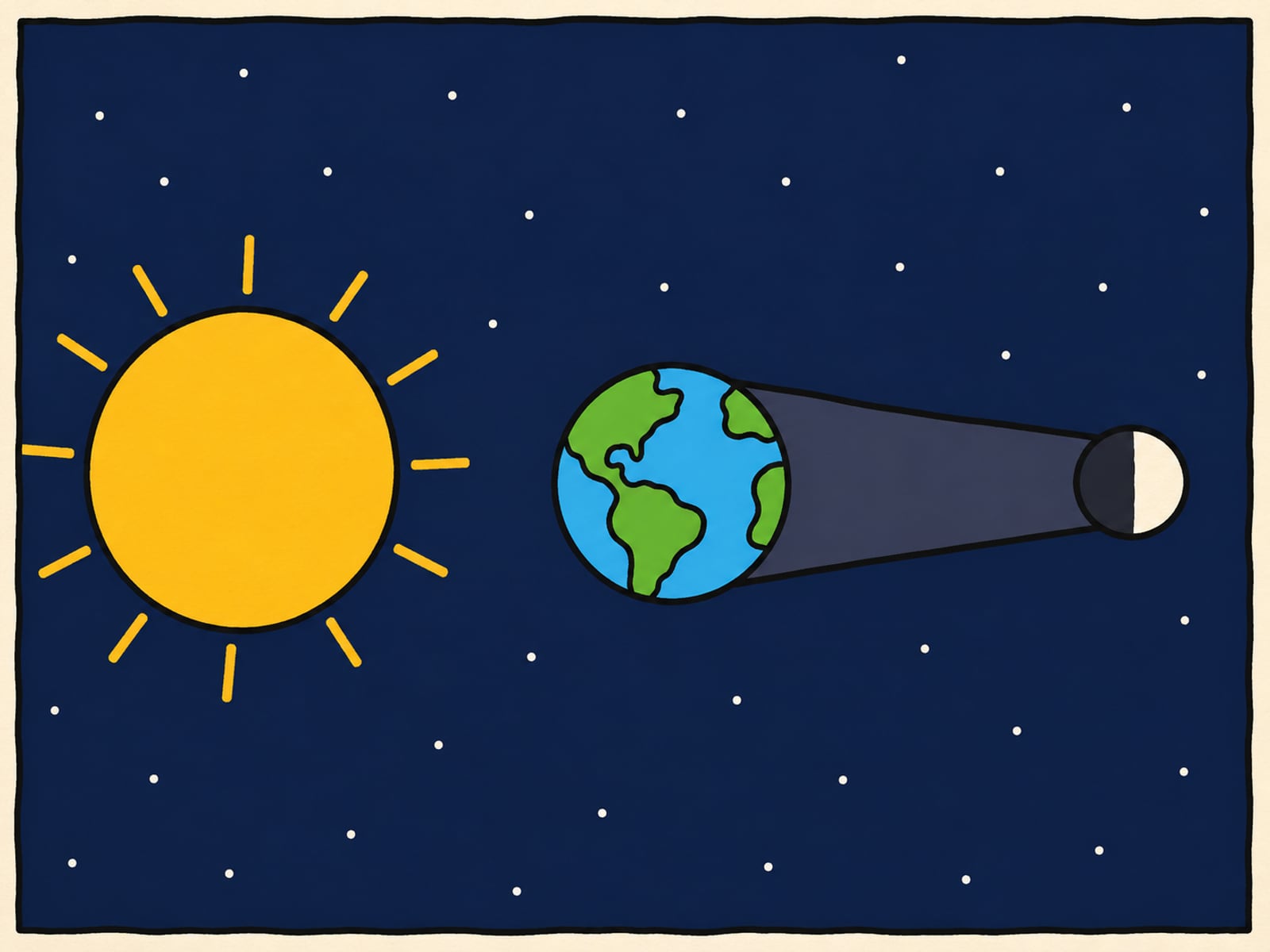
It is easy to guess that Earth's shadow takes a bite out of the Moon each month. That guess is a natural one, and it points at something real, just not at the phases.
The Sun lights half of the Moon at all times, except during an eclipse. As the Moon orbits, we see different portions of that lit half. A lunar eclipse is a separate event. It happens only when the Sun, Earth and Moon line up closely enough for the Moon to pass through Earth's shadow, and it happens at full Moon.
In other words, an eclipse needs a tight lineup. Most full Moons skip it, because the Moon's orbit is tilted relative to Earth's orbit around the Sun. NASA Science covers both points.
Three follow-up questions
Three questions come up once the lamp-and-ball picture clicks: the length of the month, the names, and how the phases ended up in calendars.
1. Why is a lunar month about 29.5 days when the Moon orbits in about 27.3?
NASA separates two different clocks. The Moon completes one orbit around Earth, measured against the distant stars, in about 27.3 days.
But Earth is also moving around the Sun. When the Moon finishes that orbit, the Sun, Earth and Moon are no longer lined up as they were at the last new Moon. The Moon has to travel a little farther before the sunlight reaches it from the same angle again. The wait from one new Moon to the next is about 29.5 days, called the synodic month or lunar month.
2. Where do names like Harvest Moon, Beaver Moon and Blue Moon come from?
They are cultural labels, not extra phases. Each one is a full Moon with a nickname, and the nicknames vary by community, region, language and hemisphere.
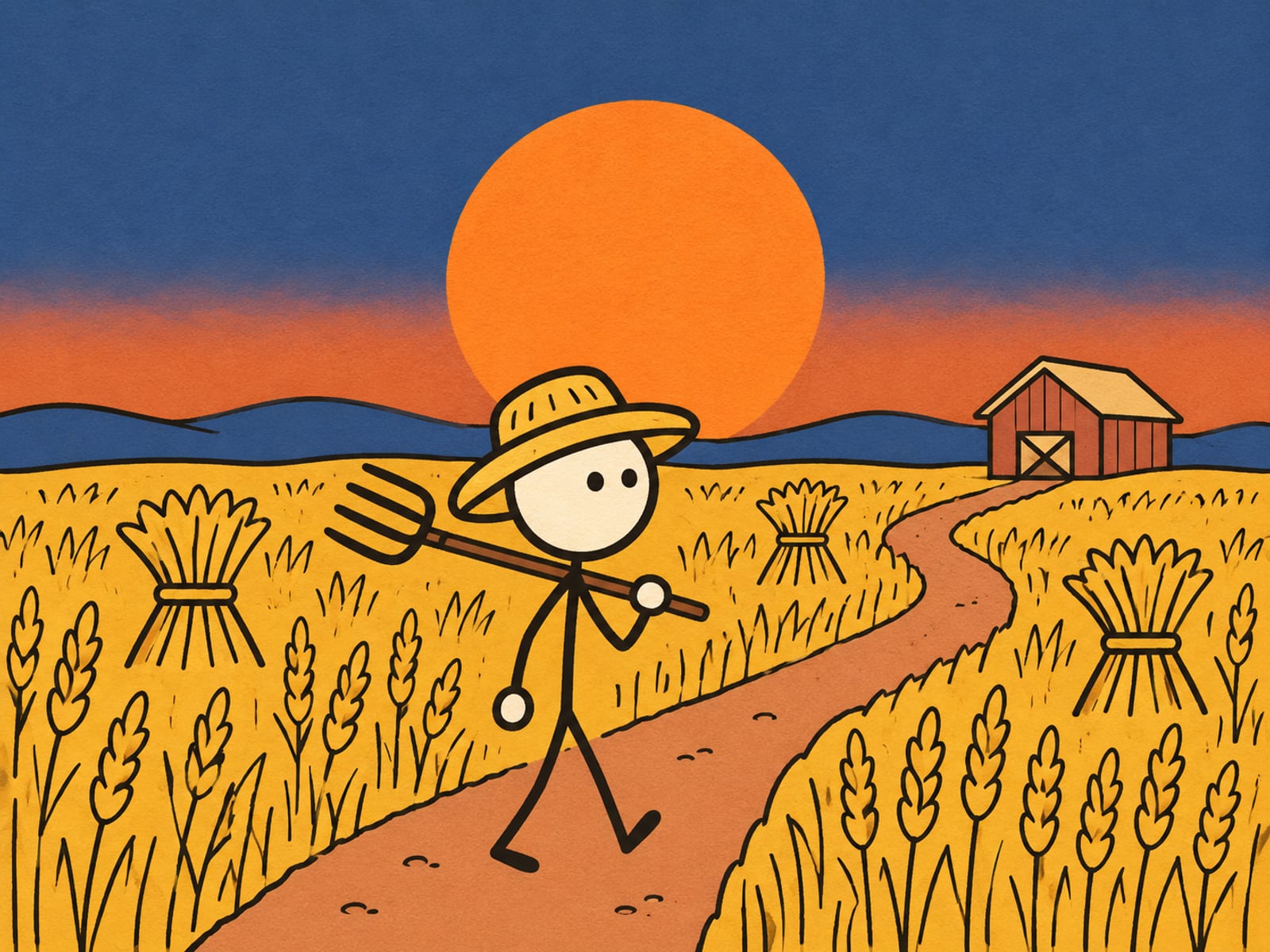
Harvest Moon is the full Moon closest to the start of autumn. NASA's Space Place says the name reflects the extra moonlight that helped farmers harvest after sunset, back before electric lighting.
Beaver Moon is a November name tied to beavers preparing winter lodges and, historically, to the North American fur trade. The Old Farmer's Almanac says names like this draw on early Native American, Colonial American and European folklore.
A Blue Moon does not usually mean the Moon looks blue. NASA describes the common modern meaning as the second full Moon in one calendar month, and an older seasonal meaning as the third full Moon in a season that has four. The calendar-month meaning grew out of a 1946 Sky & Telescope explanation of an earlier Maine Farmers' Almanac definition.
3. How did people use the phases for calendars?
A lunar calendar runs on the cycle from one new Moon to the next. The U.S. Naval Observatory defines it as a calendar based on the Moon's complete phase cycle.
The Islamic Hijri calendar has twelve lunar months. The Metropolitan Museum of Art explains that each month traditionally begins when the new crescent becomes visible, so the months drift through the seasons of the Gregorian calendar. Moon sighting matters for Ramadan and other religious dates.
Easter is a looser fit. In a simplified description, Western churches use the first Sunday after the first ecclesiastical full Moon on or after March 21. The Naval Observatory notes that this full Moon is calculated from tables, so it is not identical in every case to the full Moon you see in the sky. Eastern churches may use older Julian tables, so the dates can differ.
By the numbers
| Figure | Value | Source |
|---|---|---|
| Part of the Moon the Sun lights at any moment | half | NASA Science, "Moon Phases" |
| Days from one new Moon to the next | about 29.5 | NASA Science, "Moon Phases" |
| Days for one orbit, measured against the stars | about 27.3 | NASA Science, "Top Moon Questions" |
| Named phases in one cycle | 8 | NASA Science, "Moon Phases" |
| Year a Sky & Telescope article set off the calendar-month Blue Moon | 1946 | NASA Science, "Summer Blue Moon" |
Questions people ask
What are the eight Moon phases called? 01
In order: New Moon, Waxing Crescent, First Quarter, Waxing Gibbous, Full Moon, Waning Gibbous, Third Quarter (also called Last Quarter) and Waning Crescent. In Spanish they run: luna nueva, creciente, cuarto creciente, gibosa creciente, luna llena, gibosa menguante, cuarto menguante and menguante. Spanish speakers also use "plenilunio" for full Moon and "novilunio" for new Moon.
Is the phase the same everywhere on Earth? 02
Yes. NASA says people everywhere see the same current phase, though the Moon can look rotated or upside down from different hemispheres. The phase is the same; the observer's viewpoint is turned. Institutions publish it for their own region: the UNAM Institute of Radio Astronomy and Astrophysics in Mexico lists new and full Moons in its lunario, and Spain's Instituto Geográfico Nacional gives times in Spain's official time.
Why isn't there a lunar eclipse at every full Moon? 03
The Moon's orbit is tilted. At most full Moons it passes above or below Earth's shadow instead of through it, so it stays lit.
Why does the Moon rise later each night? 04
The Moon keeps moving eastward in its orbit while Earth turns. The result is that it rises roughly later from one night to the next. NASA's phase walk-through points this out for the waning gibbous Moon.
A month of Moon shapes is a clock
A full cycle takes about 29.5 days, and every stage of it is visible from your own window. Look at the Moon's shape and you can tell roughly where it sits in its orbit, and roughly where it stands relative to the Sun.
The Sun always lights half the Moon, and we see more or less of that half as the Moon travels around Earth.
Sources

- NASA Science, "Moon Phases"
- NASA Science, "Top Moon Questions"
- NASA Science, "Eclipses and the Moon"
- UNAWE en Español, "Fases de la Luna"
- NASA Space Place, "Supermoon, Blood Moon, Blue Moon and Harvest Moon"
- NASA Science, "Summer Blue Moon"
- The Old Farmer's Almanac, "Full Beaver Supermoon November 2026"
- U.S. Naval Observatory, "Introduction to Calendars"
- Metropolitan Museum of Art, "Astronomy and Astrology"
- U.S. Naval Observatory, "The Date of Easter"
- UNAM Institute of Radio Astronomy and Astrophysics, "Lunario IRyA 2026"
- Instituto Geográfico Nacional, "Fases de la Luna"