Why Is Mars Red?

Mars looks red because iron in its rocks, regolith and dust has oxidized, or rusted, and wind spreads the fine rusty dust into the air and across the surface. The planet isn't one uniform red, since its surface also has brown, gold and tan areas. A 2025 study in Nature Communications concluded the dust is dominated by a mineral called ferrihydrite, a refinement of the rust story rather than a replacement.

In this explainer +
Say you're an ancient Egyptian observer, looking up at the night sky. One steady reddish point holds your eye, and you already have a name for it.
NASA says the Egyptians called it "Her Desher," meaning "the red one." You were looking at Mars, and the name was fair.
The answer to why is short. Mars looks red because iron in its rocks and dust has oxidized, which is the science word for rusted, and wind carries the fine rusty dust into the air and across the surface. The color you see from here is mostly that dust.
There's a catch worth knowing early: the surface also has brown, gold and tan areas, so Mars is not one uniform red. And in 2025, a team led by Adomas Valantinas named the iron mineral that is probably doing most of the coloring.
How iron turned a planet red
Start with what's in the ground. Martian rocks and dust are rich in iron. When iron meets oxygen, it rusts, and rust is red-orange. That's the same chemistry that colors an old gate or the bottom of a neglected pan.
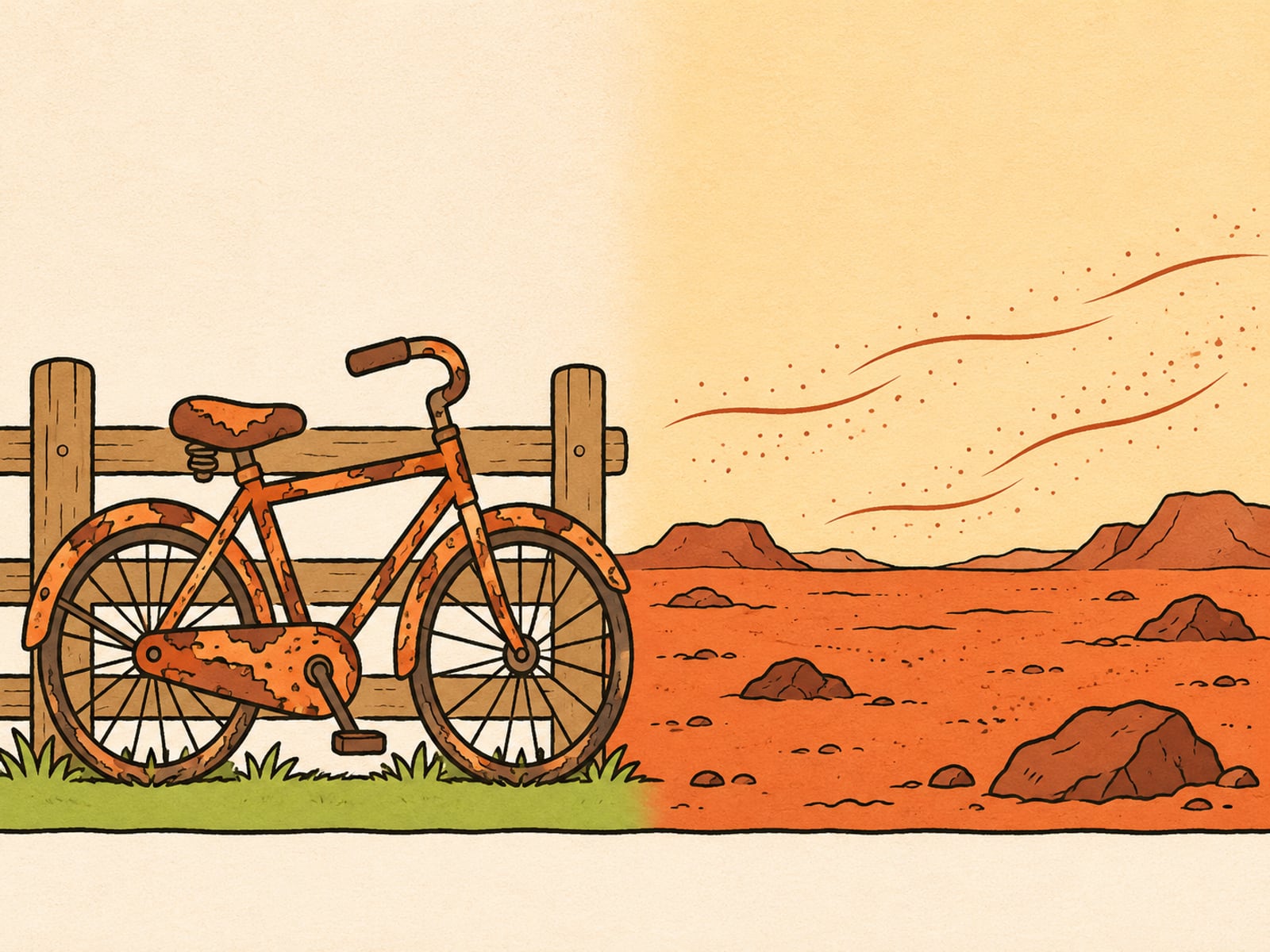
Think of it like this: a bicycle left out in the yard. Give it enough rain and enough years, and the bare metal turns orange and flakes. Now leave the flakes lying around, and let the wind pick them up. You get rust in the metal and rust in the air.
ESA's account of how Mars turned red gives the order of events. Early Mars had wetter conditions, and iron-bearing rocks reacted with water and oxygen, producing rust. Then the planet dried out, and wind broke the rusty rock into fine dust.
In other words, the red isn't paint on the surface. It's a chemical change in the rock, ground fine and carried everywhere the wind goes.
The 2025 refinement: which rust?
"Rust" isn't one thing. Iron and oxygen can combine into several different minerals, and hematite is one well-known iron oxide that the study tested against.
On February 25, 2025, Adomas Valantinas and colleagues published a study in Nature Communications with a different answer. They concluded that poorly crystalline ferrihydrite, a hydrated iron oxide, is the dominant iron oxide-bearing phase in Martian dust. "Hydrated" means it has water locked into its structure.
How did they test it? In the lab, they made mixtures of ferrihydrite and basalt, a dark volcanic rock. Those mixtures matched the readings taken from orbit and by rovers better than mixtures that used hematite and other iron minerals.
The study doesn't remove the role of oxidized iron. It refines the likely mineral. Mars is still rusty; the question was which kind of rust.
There's a second payoff. Ferrihydrite forms quickly in cold, water-rich places on Earth. So, its presence suggests that early Mars had cold, wet conditions before it dried out.

Two follow-up questions
Two questions come up right away: whether the whole planet is red, and what the rovers saw.
1. Is Mars red all over?
No, and NASA says so in What Is Mars? and its Mars facts page: the surface includes brown, gold, tan and darker colors. ESA's images show white, black, yellow, red, green and coffee-colored areas.
Darker regions are associated with volcanic minerals such as basalt. Lighter regions are often covered by silicate dust. From far away, the dust blends the colors into one reddish glow.
Stand on the surface and the sky tells the same story. NASA says the daytime sky would look hazy and red from suspended dust, while near sunrise or sunset the sky can look blue.
2. What did the rovers show about the dust?
They showed that fine reddish dust is widespread and on the move. NASA's Mars Exploration Rovers page covers Spirit and Opportunity, which landed in January 2004. Opportunity's solar panels were visibly cleaned by wind, which shows that Martian winds move dust.
Then came the storm. Opportunity stopped communicating on June 10, 2018, during a planet-wide dust storm.
The rover measurements also helped establish that Martian dust contains oxidized iron. The 2025 ferrihydrite study combined observations from Curiosity, Pathfinder and Opportunity with orbital readings and lab experiments.

The record
| Date | What happened | Source |
|---|---|---|
| July 1997 | Sojourner lands on Mars and begins returning surface data | NASA, "Rovers on Mars" |
| January 2004 | Spirit and Opportunity land and investigate rocks and soil for evidence of ancient water | NASA, "Mars Exploration Rovers: Spirit and Opportunity" |
| 2012 | Curiosity lands | NASA, "Evolution of a Martian: Sojourner to Perseverance" |
| 2014 | Wind cleans Opportunity's solar panels | NASA, "Mars Exploration Rovers: Spirit and Opportunity" |
| June 10, 2018 | Opportunity stops communicating during a planet-wide dust storm | NASA, "Evolution of a Martian: Sojourner to Perseverance" |
| 2021 | Perseverance lands | NASA, "Evolution of a Martian: Sojourner to Perseverance" |
| February 25, 2025 | Valantinas and colleagues publish the ferrihydrite study in Nature Communications | Valantinas et al., Nature Communications |
Questions people ask
Why is Mars called the red planet? 01
Because it looks red in the night sky, and people have noticed for a very long time. The Egyptians called it Her Desher, "the red one," and Spanish-language science writing still calls it "el planeta rojo," as UNAM's magazine ¿Cómo ves? does. The physical reason is the same from anywhere on Earth: iron-rich dust.
Why is Mars named after the Roman god of war? 02
NASA says the Romans named it for their god of war because its reddish look reminded them of blood. The Greeks linked it to Ares, their war god, and NASA also records the Babylonian name Nergal, tied to war and death. NASA's history volume Mars Wars is a source for the Babylonian name.
Why does Mars have blue sunsets? 03
The answer turns on how fine dust scatters and transmits different wavelengths of sunlight near the Sun. Near sunrise or sunset the sky around the Sun can look blue, even though the daytime sky looks hazy and red. NASA's page on Martian sunrises and sunsets covers it.
Why did Mars lose its water? 04
The answer turns on the planet's thin atmosphere, the loss of global magnetic protection and atmospheric escape. Some of the water is also stored as ice or in minerals. NASA's Mars facts page lays out the details.
Why the color matters now
The color is more than a pretty fact. If ferrihydrite is the main iron oxide in Martian dust, then the dust carries a record of the planet's past, because the 2025 study ties that rust to cold, wet conditions early in Mars's history.
So, the red you see from your backyard is a clue about a planet that once had water. Hematite or ferrihydrite, the story keeps the same spine.
Mars is red because its iron rusted, and the wind keeps spreading the dust.
Sources

- NASA, "Mars Facts"
- NASA, "What Is Mars?"
- ESA, "How Mars turned red"
- Valantinas et al., "Detection of ferrihydrite in Martian red dust records ancient cold and wet conditions on Mars," Nature Communications, 2025
- ESA en español, "Luz y oscuridad en Marte"
- NASA, "What Do Sunrises and Sunsets Look Like on Mars?"
- NASA, "Mars Exploration Rovers: Spirit and Opportunity"
- NASA, "Evolution of a Martian: Sojourner to Perseverance"
- NASA, "Rovers on Mars"
- NASA, "Mars Wars: The Rise and Fall of the Space Exploration Initiative"
- UNAM, ¿Cómo ves?, "Marte, más cerca que nunca"